In the previous post, we talked about Gemba, going to the floor, seeing reality, and listening to the people doing the work.
Gemba is powerful, but it creates a new challenge.
Once you really start listening, you uncover a lot of problems. Reliability issues. Process gaps. Frustrations that have been quietly accepted for years.
Very quickly, leaders face a familiar question:
What do we actually work on first?
This is where many improvement efforts stall. Not because teams don’t care, but because there’s no clear way to turn what we learn at Gemba into focused, sustained action.
That’s exactly the role Hoshin Kanri plays.
Seeing Problems Is Easy. Choosing Matters More.
Most plants don’t lack ideas.
They lack focus.
Spend enough time on the floor and you’ll hear about everything that needs fixing. Maintenance is stretched thin. PMs slip. Improvement projects start strong and then fade away.
Everyone stays busy, yet progress feels slow.
Hoshin Kanri exists to answer a hard question:
Out of everything we could improve, what truly matters right now?
It helps leaders make intentional choices instead of reacting to the loudest problem of the week.
What Hoshin Kanri Really Is (Without the Jargon)
Hoshin Kanri (often called Policy Deployment) ensures the plant’s long-term direction shows up in daily decisions.
At its core, Hoshin Kanri connects long-term direction to daily work.
It aligns what the organization wants to achieve over several years with what teams actually do this month, this week, and today.
Instead of chasing dozens of initiatives, it forces discipline.
Only a small number of priorities move forward. Those priorities shape improvement work, resource allocation, and leadership attention.
If Gemba helps you understand reality, Hoshin Kanri helps you decide where to act on it.
Why Gemba Alone Isn’t Enough
Gemba shows the truth, but it doesn’t set direction.
Without a deployment system, insights from the floor turn into long lists and good intentions.
Teams keep firefighting. Maintenance work stays reactive. Strategic improvements get pushed aside when things get busy.
Hoshin Kanri prevents that drift.
It protects the most important work from being crowded out by urgent noise..
How Targets Are Set (Catchball)
One of the most important parts of Hoshin Kanri is how targets get set.
Instead of leadership deciding everything behind closed doors, objectives are proposed, challenged, and refined through dialogue.
Teams provide input based on what they see on the floor. Leaders adjust targets before finalizing commitments.
This back-and-forth, often called catchball, keeps strategy realistic.
It connects planning to Gemba without turning it into negotiation or politics.
How a Hoshin Kanri Platform Helps (Without Overcomplicating Things)
Most Hoshin systems rely on a few simple elements.
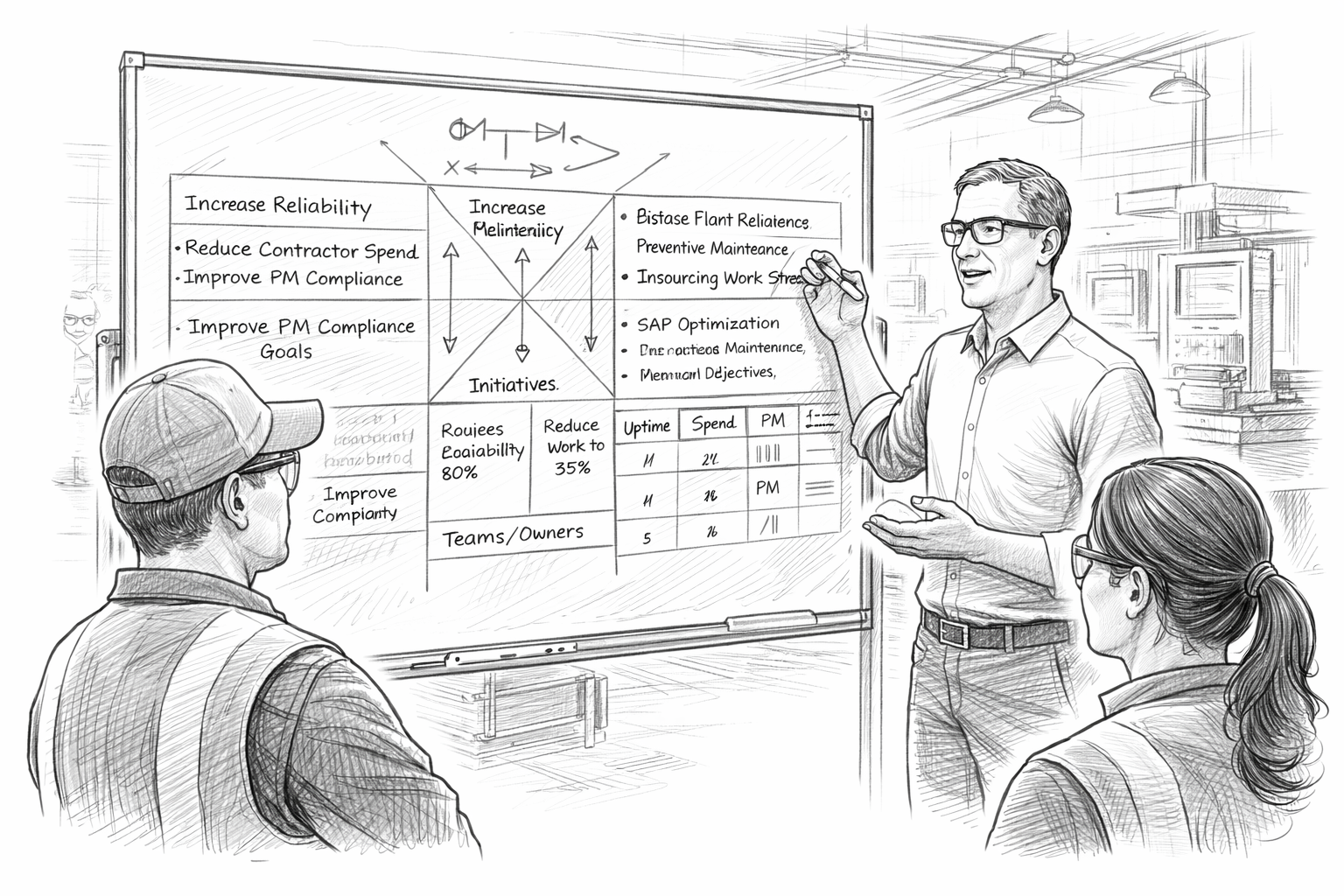
The X-Matrix makes connections visible by linking long-term direction, annual goals, improvement priorities, and KPIs on a single page.
A3s slow teams down enough to define real problems and causes before jumping to solutions.
Dashboards make progress visible, not just to leadership, but to the teams doing the work.
Regular reviews keep plans alive instead of forgotten.
These tools don’t create value on their own.
They create value because they force clarity, alignment, and shared understanding.
The platform itself isn’t the magic.
The discipline is.
How Hoshin Kanri Actually Comes to Life
This is where Hoshin Kanri proves its value.
Leadership starts by agreeing on a small number of strategic priorities.
Not everything. Just the few things that will actually move the needle this year.
For a maintenance organization, that might mean improving reliability, reducing reactive work, or strengthening PM compliance.
Those priorities shape improvement work, not the other way around.
Ownership matters here.
Every objective needs one clear owner. Not a committee. Not “the department.”
One person stays accountable for progress and for raising issues early.
From there, objectives move through catchball.
Leaders propose targets. Teams challenge what’s realistic. Adjustments follow. Commitments get finalized together.
That process builds alignment and ownership.
The Review Rhythm That Keeps It Alive
Hoshin Kanri fails when it lives only in planning sessions.
It works when the same priorities show up everywhere.
In daily huddles, in weekly maintenance planning, in leadership Gemba conversations.
When something goes off track, it becomes visible early and gets discussed openly.
This is where Gemba and Hoshin Kanri reinforce each other.
Gemba checks whether improvement work is actually changing behaviour.
Hoshin Kanri keeps that work focused on what matters most.
Most importantly, people understand why they’re doing the work, not just what they’re doing.
What Makes the Difference Over Time
Organizations that stick with Hoshin Kanri start to feel different.
People stop chasing everything.
Trade-offs become clearer.
Firefighting slowly gives way to planned work.
Improvement feels intentional instead of scattered.
The biggest shift isn’t in the tools. It’s in how decisions get made under pressure.
Gemba and Hoshin Kanri: One System, Not Two
Gemba without direction creates awareness but no momentum. Direction without Gemba creates plans that don’t survive reality.
Together, they form a system. Gemba reveals the truth. Hoshin Kanri sets focus. Daily management keeps everything moving.
When those three work together, continuous improvement stops being an initiative and starts becoming the way the organization operates.

Final Thought
Hoshin Kanri isn’t about perfection.
It’s about discipline.
If Gemba helps leaders listen, Hoshin Kanri helps them choose.
Choose what matters most.
Decide where limited time and resources should go.
And, choose to stay disciplined when daily pressure tries to pull attention elsewhere.
That’s how strategy stops living in documents and starts living on the shop floor.