There’s Much More Inside a Beehive Than Honey
When most people think about bees, honey is probably the first thing that comes to mind. Some may think about beeswax or pollen. But there is another remarkable product hidden inside every healthy beehive that I think deserves much more attention. It’s called propolis.
Beekeepers often describe it as the guardian of the hive. And, once you understand what bees use it for, it’s easy to see why. Traditional medicine has relied on propolis for thousands of years, while scientists have spent decades studying its composition and biological properties.
The more I learn about it, the more fascinating it becomes. For me, propolis is another example of something bees figured out millions of years before we ever started trying to understand how it worked.
What Exactly Is Propolis?
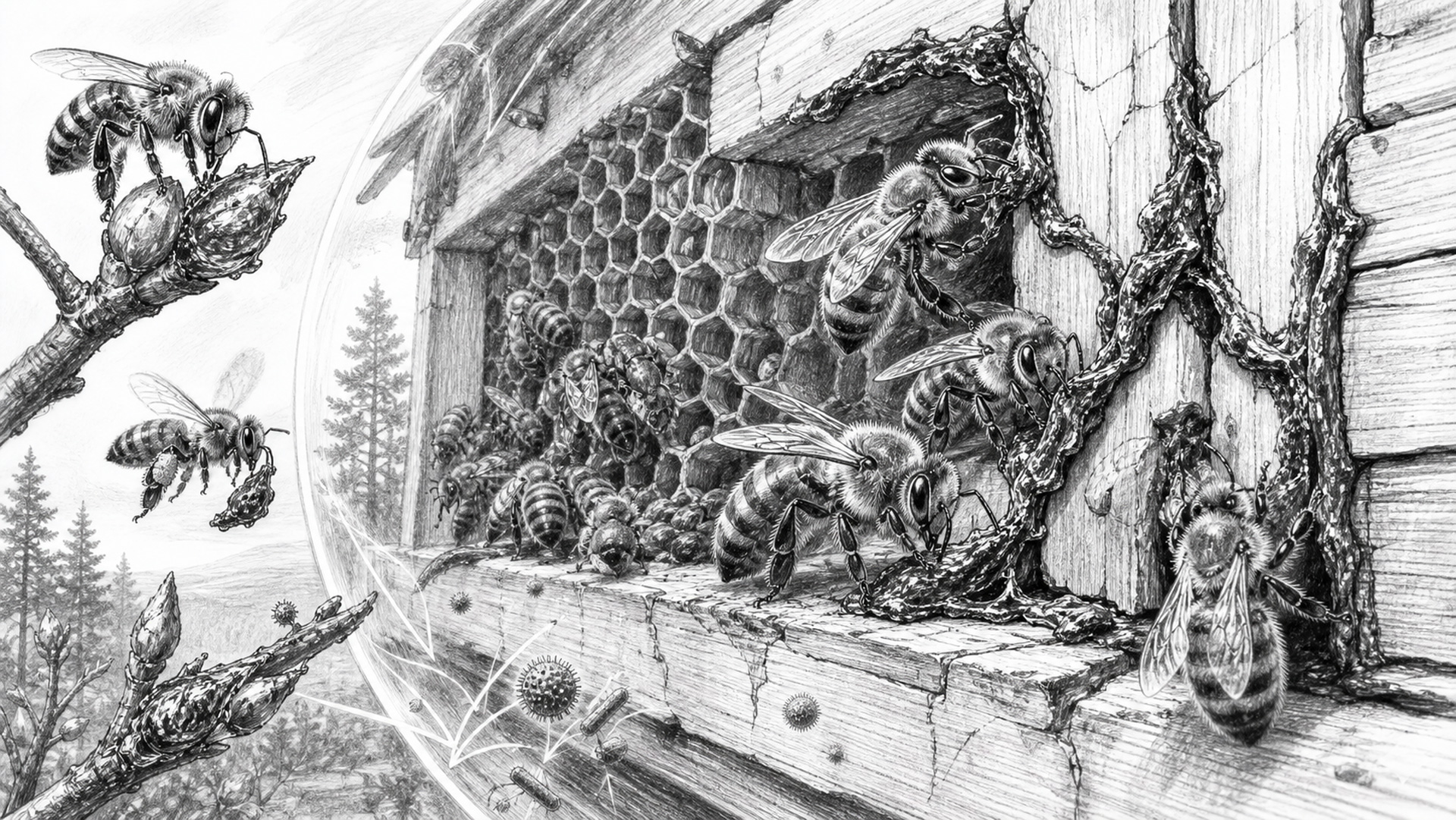
Propolis is a sticky, resin-like substance that honeybees produce from materials they collect from tree buds, bark, and other plant sources. Back at the hive, they combine those natural resins with beeswax and other substances to create a material they can use throughout the colony.
Even its name tells you something about its purpose.
The word comes from ancient Greek. Pro means ‘before’ or ‘in front of’, while polis means ‘city’. The name is commonly interpreted as something like ‘defender of the city’.
For the bees, of course, that city is the hive. And they take protecting it very seriously.
The Hive Has Its Own Defense System
Think for a moment about what life inside a beehive is actually like. Thousands of bees live together in an enclosed environment where warmth and humidity could make controlling microorganisms particularly important.
Yet a healthy colony has ways of protecting that environment, and propolis plays an important role.
Bees use it to seal small cracks and gaps, reinforce parts of the hive, and coat internal surfaces. In doing so, propolis contributes to the colony’s defenses against microorganisms.
There is an even more remarkable example.
If a small intruder, such as a mouse, enters the hive and dies somewhere the bees cannot physically remove it, they may cover the body with propolis. By effectively sealing it away, they reduce the risk that decomposition will contaminate the colony.
I find that extraordinary. Long before humans understood microbiology, bees had already developed their own way of managing a biological problem inside the hive.
What Makes Propolis So Interesting?
When researchers began looking more closely at propolis, they discovered just how chemically complex it is.
Scientists have identified hundreds of compounds in different samples, including flavonoids, phenolic compounds, aromatic substances, and other naturally occurring components.
But there is an interesting detail here: not all propolis is exactly the same.
Its composition depends heavily on geography, local vegetation, climate, and the plant sources available to the bees. Propolis collected in one part of the world can therefore have a different chemical profile from propolis produced somewhere else.
That variability makes propolis more complicated to study, but I think it also makes it more interesting. The bees are essentially working with whatever nature provides around them.
Why Scientists Continue Studying Propolis
One of the reasons propolis continues to attract scientific attention is the biological activity associated with many of its compounds.
Research has investigated its antimicrobial, antioxidant, and anti-inflammatory properties, among others. Laboratory studies have found activity against certain bacteria, fungi, and viruses, which helps explain why researchers are interested in the role propolis plays inside the hive as well as its potential applications for people.
That interest has expanded into areas such as oral care, skin care, wound healing, and other health-related applications.
There is an important distinction to make, though. Promising biological activity in research does not mean propolis should be treated as a cure or as a replacement for medical treatment.
To me, that doesn’t make it any less fascinating. It simply means we should be curious about what science is discovering without asking a natural product to be something it isn’t.
Propolis and the Natural Healing Process
Humans have used propolis in traditional remedies for centuries, particularly for wounds and skin-related applications.
Modern research has explored whether some of its compounds may support processes involved in wound healing, including inflammation and tissue repair. That continuing interest is one reason propolis now appears in various creams, ointments, balms, and other topical products.
Again, I think this is where a little perspective matters.
Propolis isn’t a substitute for professional medical care. What makes it interesting is that something bees developed to protect their own environment contains compounds that scientists are still trying to understand and potentially put to use.
A Natural Source of Antioxidants
Another area that has attracted attention is the antioxidant activity of propolis.
Our bodies naturally produce free radicals through normal metabolic processes, while environmental factors can contribute additional oxidative stress. Antioxidants help neutralize reactive molecules, which is why researchers have taken an interest in the antioxidant compounds found in propolis.
Its exact antioxidant profile varies with its botanical and geographical origin, just as its overall chemical composition does.
It’s another reminder that propolis isn’t one single standardized substance. In many ways, every sample reflects the environment the bees collected it from.
From the Beehive to Everyday Products
You don’t have to visit an apiary to encounter propolis anymore.
Walk into many natural health stores and you’ll find it in throat sprays, lozenges, toothpaste, mouthwash, tinctures, capsules, skin creams, and cosmetic products.
That’s quite a journey for something that begins as plant resin collected by a honeybee.
Its growing commercial popularity also reflects the scientific interest surrounding it. Researchers continue studying its composition, biological activity, and potential applications, while people have been using it traditionally for a very long time.
And I mean a very long time.
Humans Discovered Propolis Thousands of Years Ago
Our interest in propolis certainly isn’t new.
Ancient civilizations were already familiar with its properties thousands of years ago. Historical accounts associate the Egyptians with the use of propolis in preservation and mummification practices. Greek medicine used preparations containing propolis for wounds, while the Romans also recognized its practical medicinal value.
They obviously didn’t understand its chemistry the way researchers can investigate it today. But they knew it did something useful.
Thousands of years later, we’re still studying the same substance and discovering just how complicated it really is. I find something wonderful about that.
Is Propolis Safe for Everyone?
As fascinating as natural products can be, I think it’s important not to assume that ‘natural’ automatically means safe for everyone.
Propolis is generally used in a variety of consumer products, but it can cause allergic reactions in some people. Anyone with known allergies or sensitivities to bee products, propolis, or related plant resins should be particularly cautious and speak with a healthcare professional before using it.
The same common sense applies to propolis as it does to any supplement or health-related product.
Nature can produce remarkable things. That doesn’t mean every remarkable thing is right for every person.
Nature’s Tiny Engineers
One of the things I’ve always admired about bees is how purposeful everything inside the hive seems to be.
Honey provides stored food and energy. Wax gives the colony its structure. Pollen provides essential nutrients. Royal jelly plays a specialized role in feeding developing larvae and the queen.
And propolis helps protect the home they all depend on.
When you look at the hive as a complete system rather than simply a place where honey comes from, it becomes difficult not to admire the engineering behind it. Maybe that’s one reason I’ve always been fascinated by bees. Whether we’re looking at a beehive or a manufacturing plant, the strongest systems work because every part has a purpose and contributes to the whole.
Nothing seems accidental. Every material has a job.
And together, thousands of tiny insects create and maintain an extraordinarily sophisticated living system.
Much More Than Another Bee Product
That’s ultimately what fascinates me about propolis.
It isn’t simply another substance we collect from a beehive. For the bees, it’s part of a defense system that has helped colonies protect their living environment for millions of years.
For us, it’s something humans have valued for thousands of years and that modern science continues to investigate.
We still have much to learn about its chemistry, biological properties, and potential applications. But perhaps that’s part of what makes it so interesting.
The next time you see a honeybee moving from plant to plant, remember that honey is only part of the story.
Somewhere inside the hive, those bees are building, feeding, repairing, communicating, protecting, and using one of nature’s most fascinating materials to help keep their little city alive.
Sometimes the smallest engineers leave us with the biggest questions.
And if you enjoy exploring ideas about nature, learning, leadership, and the systems around us, connect with me on LinkedIn. I’d be happy to continue the conversation there.