My Interest in Bee Venom Started With Something Unexpected
Most people don’t think of a bee sting as a good thing.
We associate it with pain, swelling, and that immediate instinct to get as far away from the bee as possible. I understood that too. But after I started working closely with bees, my perspective became a little more complicated.
Before I began working with them, I had already been diagnosed with arthritis. Over the next two or three years, I was stung many times while handling bees and researching bee products. During that period, I noticed something I hadn’t expected: my arthritis pain gradually decreased.
At my next medical checkup, my doctor observed an improvement of about 80%. I hadn’t made any major changes to my diet, medication, or daily routine. The obvious difference in my life was that I was spending a lot of time working with bees, and getting stung by them.
Now, I want to be very careful here. My experience doesn’t prove that bee venom caused the improvement, and I would never suggest that bee stings are a treatment for arthritis. One person’s experience isn’t medical evidence. But it certainly made me curious.
I wanted to understand what bee venom actually contains, why scientists study it, and whether there might be more to this tiny drop of venom than the pain we associate with a sting.
As it turns out, researchers have been asking many of the same questions.
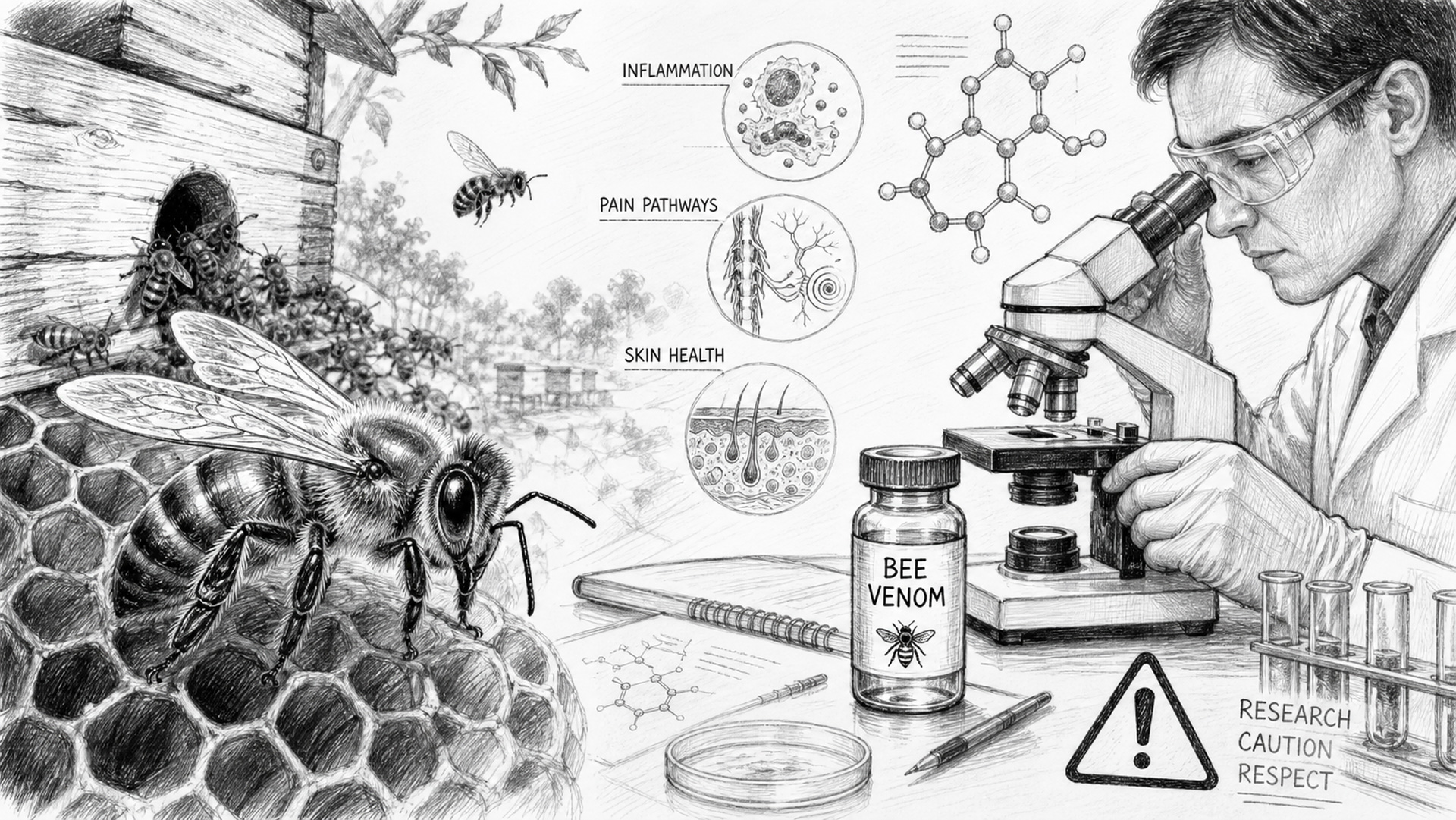
What Exactly Is Bee Venom?
Bee venom is a natural fluid produced by worker bees and queens. For the bee, its purpose isn’t complicated. It’s a defense mechanism.
A beehive contains a lot worth protecting: honey, pollen, developing larvae, and, of course, the queen. When the colony is threatened, worker bees can use their stingers to defend it. When a bee stings, a small amount of venom enters the skin. What makes that venom so interesting is its chemical complexity. It contains a mixture of peptides, proteins, enzymes, and other biologically active compounds.
One of the most extensively studied is melittin. Researchers have also investigated components such as apamin, adolapin, phospholipase A2, and hyaluronidase.
For the bee, these compounds are part of an effective defense system. For scientists, they’ve become the starting point for a completely different conversation.
Why Bee Venom Benefits Are Getting Attention
What makes bee venom particularly interesting is that some of its components interact with biological processes involving inflammation, pain, and immune responses. That’s why researchers have investigated bee venom for decades and why interest continues today.
That doesn’t make it a miracle cure. It does make it worth studying.
I think that distinction is important because natural products often get pushed toward one of two extremes. They’re either dismissed because they sound unconventional or promoted as cures before the evidence supports those claims.
Neither approach helps us understand them. I’d rather stay curious about what the research may eventually tell us.
What Researchers Are Learning About Inflammation
One of the most frequently studied areas is the potential relationship between bee venom and inflammation. Inflammation is part of the body’s normal response to injury and infection. When it becomes persistent, however, it can be associated with pain and various health conditions.
Researchers have investigated whether compounds found in bee venom may influence inflammatory pathways and help regulate certain inflammatory responses. This is one reason bee venom has attracted interest in research involving conditions associated with inflammation and discomfort.
Naturally, this part of the research became particularly interesting to me because of my own experience with arthritis. But interesting and proven aren’t the same thing. There is still much to learn.
The Connection With Pain Is Equally Interesting
Bee venom has also been used in traditional practices for pain management, and modern researchers continue investigating whether some of its components can influence the body’s pain pathways.
Studies have explored potential applications involving joint pain, muscle discomfort, and other forms of chronic pain. The evidence isn’t sufficient to treat bee venom as a broadly proven pain treatment, but the research helps explain why the subject continues to attract attention.
For me, that’s where my personal story belongs.
It isn’t proof. It’s the reason I became interested enough to keep asking questions.
From Bee Stings to Skincare
Interestingly, bee venom research hasn’t remained confined to pain and inflammation. It has also made its way into skincare.
Today, you’ll find bee venom in creams, serums, facial masks, ointments, and other cosmetic or wellness products. Some products are marketed around claims of firmer or healthier-looking skin, and researchers have investigated potential effects related to circulation and skin renewal.
As with any skincare ingredient, products and concentrations vary, and marketing claims shouldn’t be confused with clinical evidence.
Still, I find the transition fascinating. A substance bees developed to defend themselves is now being studied and incorporated into products designed for completely different purposes.
Researchers Are Looking at More Than Pain and Skin
The scientific interest extends further.
Bee venom has been studied for potential antimicrobial activity against certain microorganisms. Researchers are also investigating how some of its components interact with the immune system, including research related to inflammatory and autoimmune conditions.
Again, these are areas of ongoing research rather than established reasons to treat yourself with bee venom.
And that distinction becomes especially important when we talk about bee venom therapy.
What Is Bee Venom Therapy?
Bee venom therapy is one form of apitherapy, the broader use of products from bees for health-related purposes.
Depending on the practice, bee venom therapy can involve controlled exposure to live bee stings or preparations containing purified venom. Some practitioners use it with the intention of addressing pain, inflammation, or other conditions.
This is where I would strongly separate curiosity from experimentation.
Bee venom isn’t something people should casually try because they read about potential benefits online.
A bee sting can trigger a severe allergic reaction, including anaphylaxis. For someone who is allergic, that can become a life-threatening emergency.
So while my own experience made me curious about bee venom, I would never encourage someone to reproduce it deliberately.
Natural Doesn’t Mean Harmless
That’s probably the most important point in this entire article.
Bee venom is powerful precisely because it is biologically active. And bee venom is not safe for everyone.
People with known bee allergies or a history of severe allergic reactions need to be particularly cautious. The original article also raises additional considerations for people who are pregnant or breastfeeding, have chronic health conditions, or take medications that could affect treatment decisions. Anyone considering bee venom for a health-related purpose should discuss it with an appropriate healthcare professional first.
I’ve always believed we can admire what nature produces without pretending that natural automatically means harmless.
Respect has to come with curiosity.
What Does the Science Actually Say?
This is where I think we need to keep our feet firmly on the ground.
Bee venom is a fascinating research subject, and scientists have reported promising findings in laboratory studies and some clinical research. At the same time, more robust research is needed before broad medical claims can be made.
So if you’re researching bee venom benefits for inflammation, pain, skincare, or another health concern, I’d be cautious about dramatic promises.
Look for evidence. Talk to qualified healthcare professionals.
And remember that ‘scientists are studying this’ and ‘science has proven this treatment works’ are two very different statements.
That doesn’t diminish the subject. For me, it makes it more interesting.
Another Remarkable Product From a Tiny Creature
The more time I’ve spent around bees, the more impressed I’ve become by everything they produce.
There’s honey, of course. But there is also wax, pollen, royal jelly, propolis, and venom. Each serves a purpose within the remarkable system of the colony.
Bee venom may be the least inviting of them, but perhaps that’s precisely why I find it so fascinating. Something we instinctively associate with pain contains a complex collection of compounds that scientists are still trying to understand.
What protects the hive may also teach us something about biology, inflammation, pain, and the way naturally occurring compounds interact with the human body.
But we have to let good science determine what those lessons actually are.
A Sting That Left Me With Questions
My own experience is what brought me to this subject.
After years of working with bees and experiencing many stings, I saw a significant improvement in my arthritis symptoms. My doctor noticed the improvement too. I can’t tell you that bee venom caused it, and my experience alone could never establish that.
What I can say is that it changed the way I looked at bees. It gave me another reason to learn. And perhaps that’s the part I value most.
We don’t need to turn every interesting observation into a miracle cure. Sometimes an observation should simply make us curious enough to ask better questions and let the evidence take us from there.
Bee venom remains one of nature’s more surprising substances: powerful enough to defend a tiny insect, complex enough to keep scientists studying it, and potentially dangerous enough that it deserves our respect.
Sometimes, nature’s most interesting lessons really do come with a sting.
If you enjoy exploring ideas about bees, nature, learning, and the things that make me curious, connect with me on LinkedIn. I’d be happy to continue the conversation there.