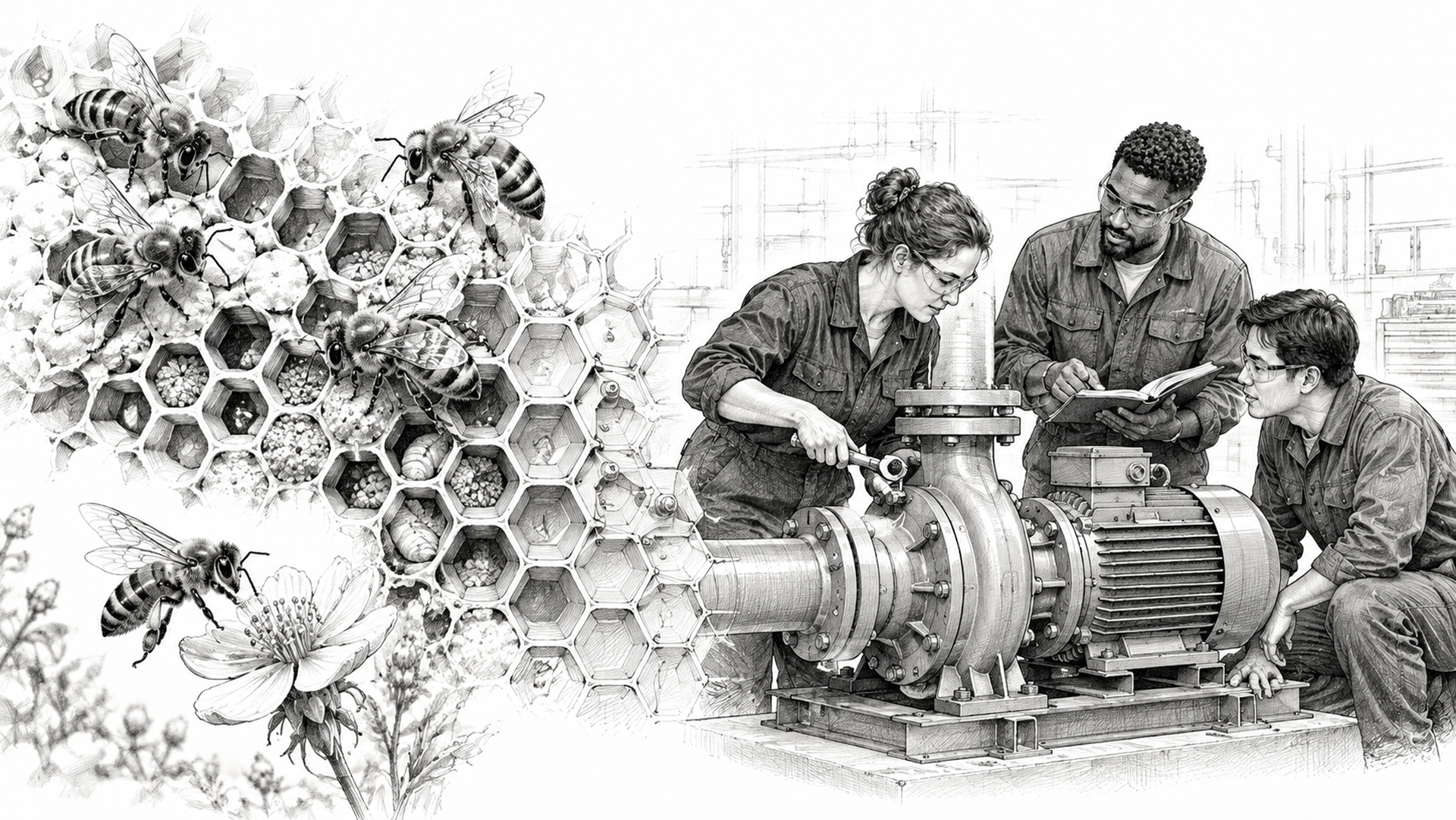
Have you ever stopped for a moment to watch a bee moving from flower to flower?
It’s such an ordinary sight that we rarely give it much thought. But when you think about what goes on inside a beehive, it’s pretty remarkable. Thousands of bees working together, each doing its part, keeping the colony alive and adapting to whatever nature throws at them.
And somehow, watching these tiny creatures got me thinking about maintenance and leadership.
I know, bees and industrial maintenance don’t exactly sound like an obvious combination. But the more I thought about it, the more similarities I found.
A Good Team Doesn’t Need Superheroes
One of the things I find fascinating about bees is how well they work together. Some collect food, others care for the young, build and maintain the hive, or protect the colony. Each has a role, and the survival of the colony depends on all of them doing their part.
Now, think about a maintenance team. Over the years, I’ve seen how easy it is for an organization to become dependent on one or two exceptionally skilled people. You know the ones. Whenever something breaks down, everyone knows exactly whom to call. They seem to have an answer for everything, and somehow, they always manage to get things running again.
Having people like that is great, but what happens when they’re on vacation, retire, or decide to move on? That’s when we realize that relying too heavily on a few individuals isn’t necessarily a sign of a strong team. I’ve explored this problem before when writing about how to preserve the knowledge of experienced technicians
To me, good maintenance leadership is about building a team where people share what they know, help each other improve, and understand how their individual work contributes to the overall operation. We don’t need everyone to know everything. We need people who can rely on one another.
Maintenance Is a Team Effort, Just Like a Beehive
Think about what it takes to keep a plant running reliably.
An operator notices that a machine sounds a little different and reports it. A technician investigates before the problem becomes serious. A planner makes sure the necessary parts and resources are available. Someone completes a preventive maintenance task properly, while someone else takes the time to document a recurring issue.
None of these actions is particularly spectacular on its own. Most of them probably go unnoticed.
But together, they make the difference between a plant that constantly reacts to breakdowns and one that operates reliably.
That’s what I find interesting about the beehive. Its success isn’t the result of one extraordinary bee. It’s the combined effort of thousands of small contributions.
And I think maintenance works much the same way.
What Happens to the Knowledge We Gain?
Here’s another interesting thing about bees. When a honeybee discovers a good food source, it can return to the hive and communicate its location to other bees through a remarkable behaviour known as the waggle dance. It doesn’t keep that information to itself. Other bees can use it to find the food.
Now, imagine applying that same principle to maintenance. Let’s say a technician spends hours troubleshooting a difficult equipment failure and finally figures out what caused it. That’s valuable knowledge. But what happens next? Does that information stay in the technician’s head, or do we make sure the rest of the team can benefit from it? I’ve always believed that one of the biggest opportunities in maintenance is improving how we share what we learn.
We have work orders, maintenance management systems such as SAP, failure analyses, and plenty of ways to document information. Yet having the tools doesn’t automatically mean we’re using them effectively. If we solve the same problem three times because nobody documented what happened the first time, we’re wasting time and resources. And if years of experience walk out the door when someone retires, we lose much more than an employee.
A strong maintenance team shouldn’t have to rediscover the same solutions over and over again.
Even a Beehive Knows When to Adapt
Nature doesn’t stand still, and neither does a beehive.
Food sources change with the seasons. Weather conditions shift. New threats appear. Bees respond to those changes to keep the colony functioning.
In maintenance, we face our own version of this every day.
Equipment gets older, production demands change, new technologies become available, and our understanding of equipment failures improves.
Yet how often do we continue performing the same preventive maintenance tasks simply because they’ve been on the schedule for years?
I’m not suggesting we should constantly change everything. Far from it. Consistency is important in maintenance.
But consistency shouldn’t mean refusing to question what we’re doing.
Every so often, we should ask ourselves whether a PM is still useful, whether we’re inspecting the right components, or whether the frequency still makes sense. That’s why I believe in periodically reviewing and improving preventive maintenance programs.
Maybe a task that was necessary five years ago is no longer relevant. Or perhaps a recurring breakdown is telling us that our current approach isn’t working.
To me, reliability isn’t about following a maintenance plan without question. It’s about having a good plan and being willing to improve it as we learn.
Maintenance Is About More Than Fixing Equipment
This is something I feel strongly about. When people think about maintenance, they often picture someone repairing a broken machine. And yes, that’s part of the job. But I believe the real value of maintenance goes much further.
Good maintenance protects a plant’s ability to produce. Every failure we prevent means less unplanned downtime. Every well-planned job reduces unnecessary disruption. Every lesson we document can save hours of troubleshooting in the future. And every technician we help develop makes the entire team more capable.
That’s why I’ve never liked looking at maintenance as just a department that fixes things when they break.
A good maintenance organization helps protect production capacity and, in many cases, creates opportunities to improve it.
It’s a different way of looking at the same work, but I think it changes how we approach our responsibilities.
Instead of asking only how quickly we repaired something, we should also be asking what we could have done to prevent the failure in the first place.
Leadership Means Building the Team, Not Doing Everyone’s Job
Of all the connections between bees and maintenance, this might be my favourite.
As leaders, it’s tempting to jump in and solve every problem ourselves, especially when we know we can get things done quickly. I’ve always thought there’s a fine line between being helpful and becoming the person everyone depends on for every decision.
If the team can’t function without the manager constantly stepping in, something isn’t working as well as it should.
Our responsibility as leaders is to give people what they need to succeed. I’ve talked before about how consistent leadership practices support daily management, and I think the same principle applies here.
That means clear expectations, proper training, the right tools, access to information, and the confidence to make decisions within their responsibilities. It also means listening, removing obstacles, recognizing good work, and allowing people to learn from experience.
Of course, there are times when a leader needs to get directly involved. But that shouldn’t be the only way things get done.
I think one of the best measures of leadership is how well the team performs when the leader isn’t in the room. A good leader doesn’t need to be the hero of every story.
Sometimes, the best thing we can do is help someone else become capable of solving the problem.
Never Underestimate the Small Things
There’s one last lesson I take from bees, and it brings everything together.
A single bee visiting a flower might not seem particularly important. But when millions of bees go about their work, the collective impact on pollination and our food supply is enormous.
Maintenance is full of those seemingly small moments.
A five-minute conversation with an operator. A properly completed inspection. A small adjustment to a PM. A better description in a work order. A technician taking the time to show a colleague how something works.
These aren’t the things that usually get celebrated in meetings. They don’t make impressive presentations or attract much attention. But they’re exactly the things that build a reliable operation over time. It’s something I’ve also discussed when looking at how daily management turns strategy into consistent action.
I’ve seen how much difference it makes when people stop thinking only about their individual tasks and start understanding how their work affects everyone else.
And that’s where leadership comes in. We need to help people see that bigger picture
So, What Can We Learn From Bees?
For me, the biggest lesson is that a successful organization doesn’t depend on one exceptional individual.
It depends on people working together, sharing what they know, adapting when things change, and taking pride in doing their part.
The same applies to maintenance.
We can have the best technology, the most sophisticated maintenance software, and all the procedures in the world. But without capable people who communicate and work together, none of it will deliver its full potential.
The next time you see a bee moving from flower to flower, think about the incredible system behind that tiny creature.
And maybe think about your own team.
Are we sharing what we learn? Are we helping people grow? Are we improving the way we work, or simply repeating what we’ve always done?
Because in the end, building a reliable plant isn’t about having one person who can fix everything.
It’s about building a team that makes reliability everyone’s responsibility.
And I think that’s a pretty good lesson to learn from a bee.
For more thoughts on maintenance, reliability, and leadership, feel free to connect with me on LinkedIn.