From Planning to Precision
If you’ve spent any time inside a manufacturing plant, you’ve probably seen how reliability transformation usually unfolds. It starts with chaos, moves toward control, and eventually reaches a point where things feel… stable. Planning improves. KPIs start trending in the right direction. Processes become more structured. And yet, even in well-managed environments, something still feels off.
Execution isn’t always consistent. That’s the gap most teams struggle to close, and it’s exactly where solutions like SquareMethods begin to make a real difference. Not by replacing existing systems, but by strengthening the link between strategy and what actually happens on the shop floor. Reliability systems only work when daily execution remains consistent, which is why strong daily management systems become critical in mature manufacturing environments.
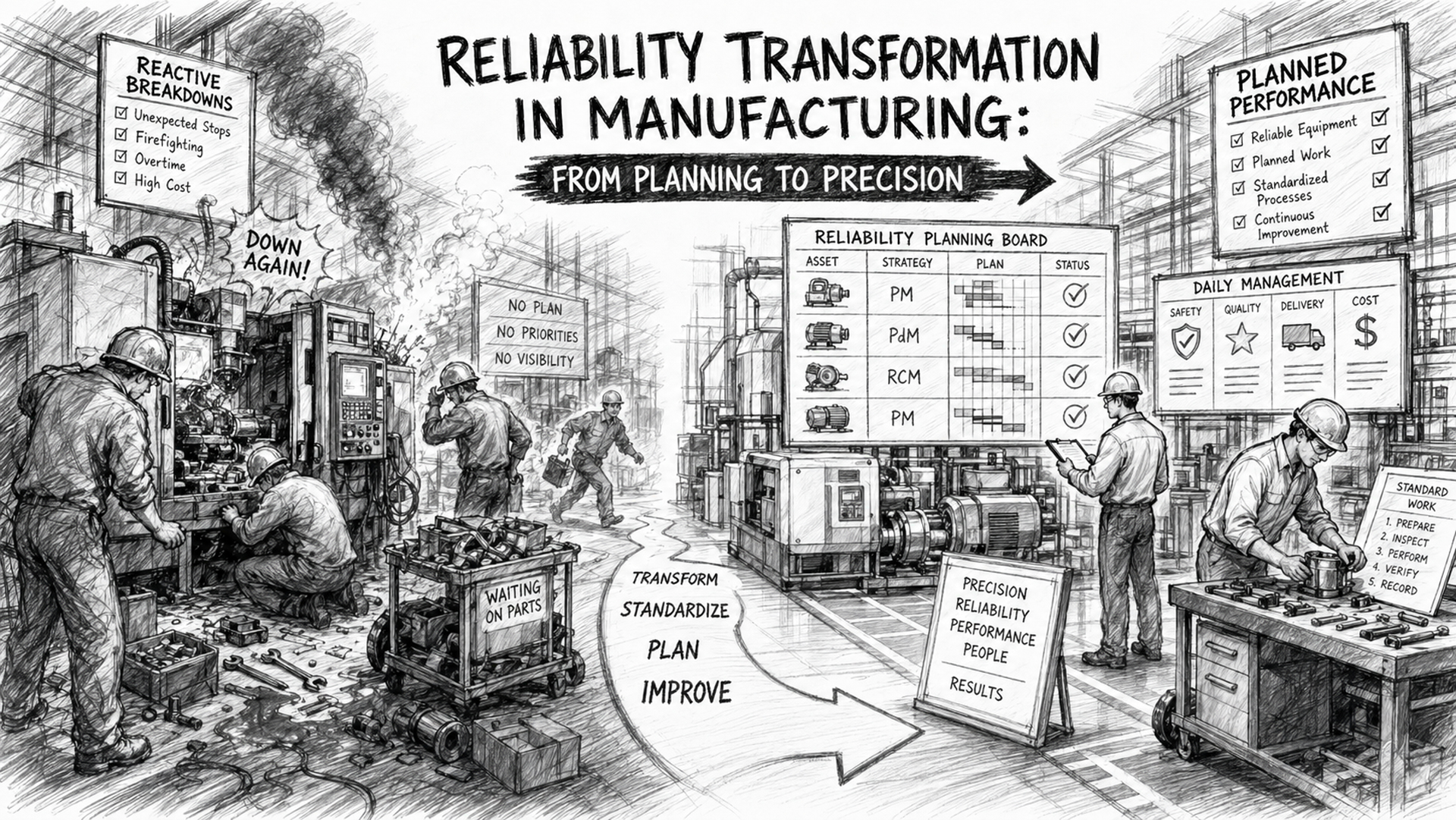
The Reliability Journey Always Starts With Foundations
A true reliability transformation in manufacturing doesn’t begin with tools. It begins with discipline. If you look at companies like Mondelez International, the approach is always progressive. Everything starts with stabilization. At that stage, the focus is simply on regaining control. Breakdowns are frequent, maintenance is reactive, and planning is either weak or nonexistent. The goal is to stop the bleeding, restore basic equipment conditions, and build a backlog that can actually be managed.
Once that foundation is in place, the organization moves into a phase of control and discipline. This is where planning and scheduling start to stick. Preventive maintenance becomes more reliable, and data slowly becomes something you can trust. Systems like SAP PM typically anchor this phase, helping teams standardize job plans and improve visibility. From there, the focus shifts toward true reliability. Instead of reacting to failures, teams start eliminating them. Root cause analysis becomes part of daily work, critical assets are clearly defined, and maintenance becomes proactive rather than reactive. At this point, the organization is no longer just managing work. It’s improving how work is done.
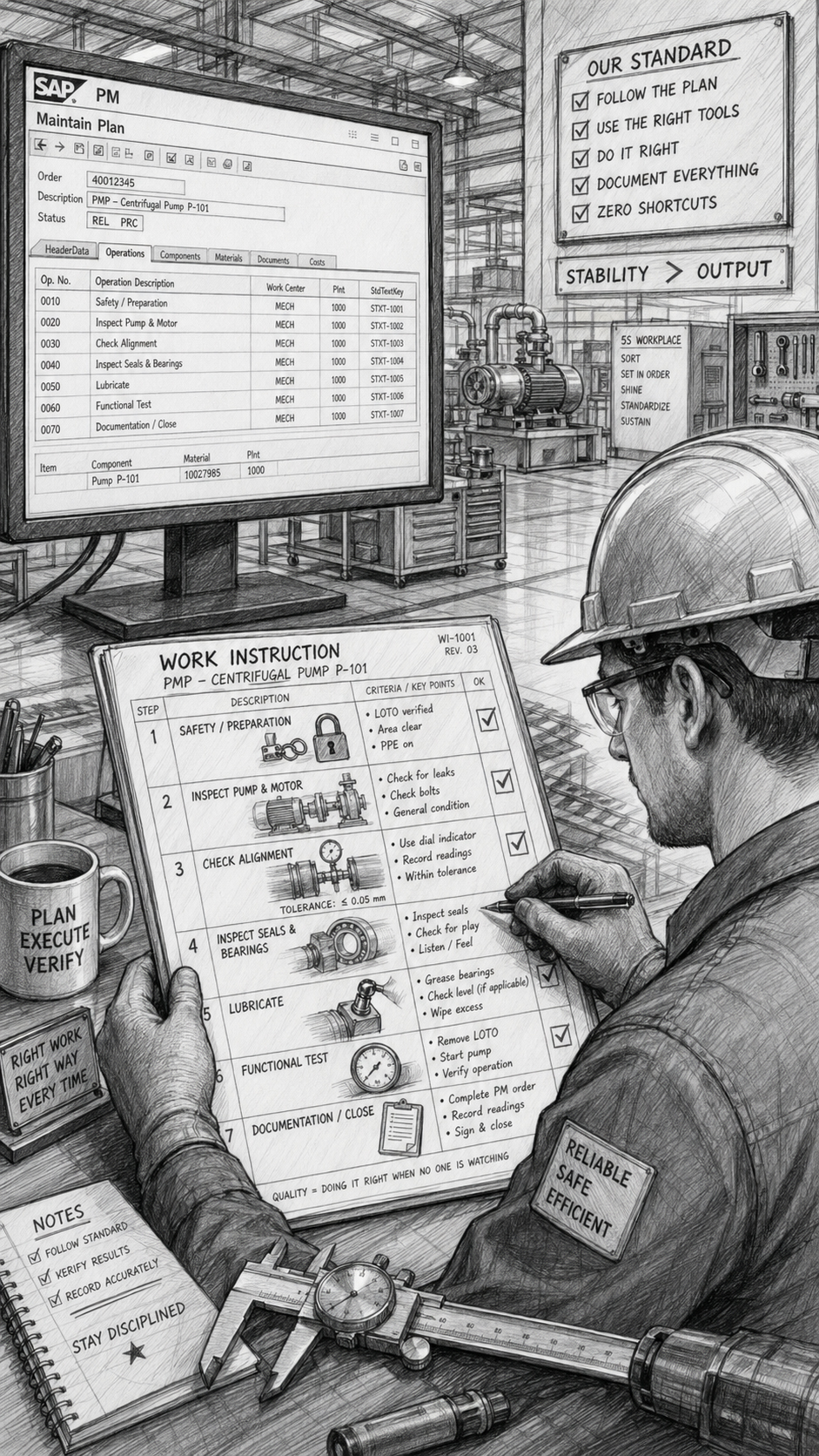
Moving From ‘What to Do’ to ‘How to Do It’
Most maintenance systems are very good at answering certain questions. They tell you what needs to be done and when it should happen. What they don’t guarantee is how the job is actually executed. That gap is bigger than it seems. Because no matter how strong your planning is, if execution varies, results will vary too.
This is where SquareMethods fits in naturally. It adds a layer that standardizes execution, making sure that every task is carried out the right way, every time. Instead of relying purely on individual experience, technicians are supported with clear, structured guidance. Work becomes more repeatable, more predictable, and ultimately more reliable. In many plants, execution variability decreases significantly when leaders establish clear routines through leader standard work.
Where Most Plants Hit a Wall
Here’s where things get interesting. Even after all that progress, many plants reach a plateau. They have solid plans, clear strategies, and capable teams. On paper, everything looks right. But in reality, execution still varies.
The same job done by two different technicians can produce two different results. Procedures exist, but they’re not always followed the same way. Small deviations add up, and over time, they create inconsistency that’s hard to eliminate. This is the moment where reliability transformation in manufacturing either continues forward or quietly stalls.
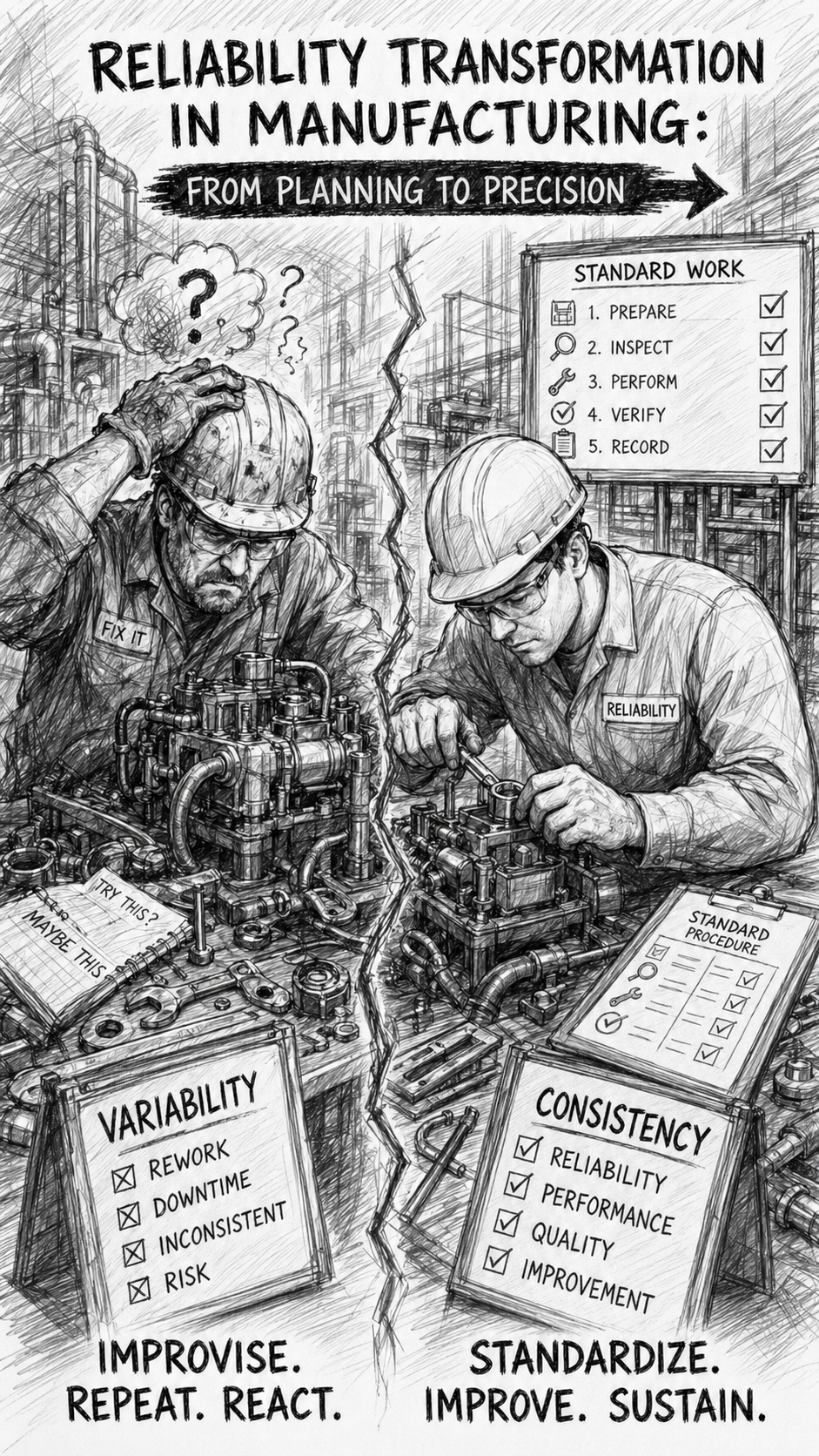
What Actually Changes on the Shop Floor
When execution becomes standardized, the shift is noticeable almost immediately. Work stops depending entirely on who performs it. Procedures are no longer just documents sitting in a system. They become part of the workflow. Technicians have clear direction, expectations are aligned, and the variation between ‘good’ and ‘average’ execution starts to disappear.
Over time, this consistency translates into measurable improvements. Equipment runs longer between failures, troubleshooting becomes more effective, and recurring issues start to fade. Perhaps even more importantly, newer technicians ramp up faster because knowledge is no longer locked inside individual experience.
Why Execution Consistency Drives Real Results
At a certain point in a reliability transformation in manufacturing, the biggest gains no longer come from better planning. They come from better execution. When work is done consistently, failures caused by human variation drop. Maintenance becomes more precise, and the system as a whole becomes more predictable. This is where performance indicators start to move in a meaningful way. Reliability improves not because more work is done, but because the work that is done is done right.
A Practical Way to Move Forward
The most effective way to introduce this kind of capability is not by going all in at once. It usually starts small. One stable line, a handful of critical tasks, and a focused effort to capture the best knowledge available. That knowledge is then turned into structured, easy-to-follow procedures that can be tested, refined, and improved over time. As results become visible, confidence grows, and scaling becomes much more natural.
Final Thoughts
Technology alone rarely solves reliability problems, especially when implementation lacks operational discipline and clear ownership. A reliability transformation in manufacturing isn’t defined by the tools you implement. It’s defined by the discipline you sustain. Systems like SAP PM help you plan. Platforms like SquareMethods help you execute with precision. The early stages of transformation build the engine. This next stage ensures it runs exactly the way it should. If your plant already has strong planning and reliability fundamentals, the next step becomes clear. It’s about removing variability from execution. Because in the end, reliability isn’t what you plan. It’s what you consistently do.