More Than a Repair Department
Walk into a great maintenance shop and you’ll notice something interesting almost immediately.
Yes, you’ll see tools, work orders, technicians moving between jobs, and teams responding to the daily demands of production. On the surface, it looks like any other maintenance department. But underneath all of that, something much more important is happening. People are learning.
The strongest maintenance organizations are not simply repair departments. They are learning environments. Every breakdown becomes a lesson, every troubleshooting effort creates new understanding, and every experienced technician becomes a source of operational knowledge that helps others grow. The real value comes when those lessons are captured and shared across the organization instead of remaining isolated to one team or one event. The challenge is making sure that knowledge stays with the organization long after the individual moves on.
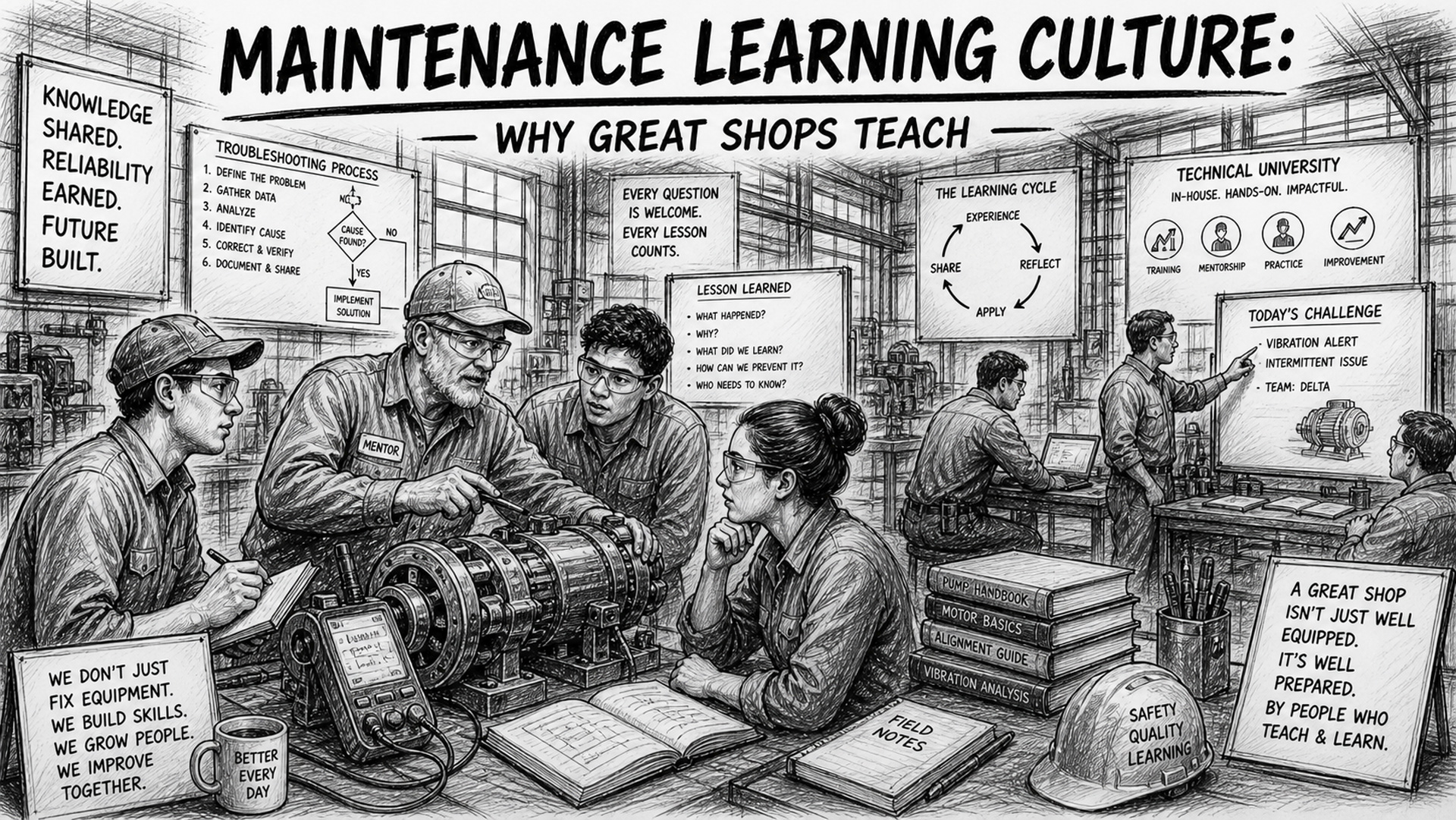
In many ways, a maintenance shop should function like a university. Not the kind built around classrooms and exams, but a living technical institution where knowledge is continuously developed, shared, improved, and applied in real time.
Because maintenance is not static work.
The Job Keeps Changing
A generation ago, a technician could spend most of their career working with relatively stable technologies. Today’s maintenance professionals operate in a very different environment.
Equipment is becoming more connected. Automation is expanding. Control systems are becoming more sophisticated. Data is increasingly part of daily decision-making. Reliability expectations continue to rise.
The modern technician is often expected to understand mechanical systems, electrical systems, controls, sensors, networks, automation logic, reliability concepts, and increasingly, data interpretation.
And the pace of change shows no signs of slowing down.
This is why continuous learning can no longer be treated as something that happens once or twice a year. It has to become part of the culture itself.
The organizations that succeed in the future will not necessarily be the ones with the newest equipment. They will be the ones that learn fastest, preserve knowledge, and adapt faster than everyone else.
When Learning Becomes Reactive
Unfortunately, many organizations still approach training the same way they approach breakdowns.
They wait for a problem.
A new machine arrives, and a vendor training session is scheduled. A major failure exposes a skill gap, and suddenly training becomes a priority. A senior technician retires, and only then does leadership realize how much undocumented knowledge just walked out the door.
Learning becomes reactive.
The problem with reactive learning is that it always arrives late.
By the time the need becomes obvious, the opportunity to prepare has already passed.
Great maintenance organizations take a different approach. They treat learning as an ongoing process rather than an occasional event.
The Problem With Knowledge Hoarding
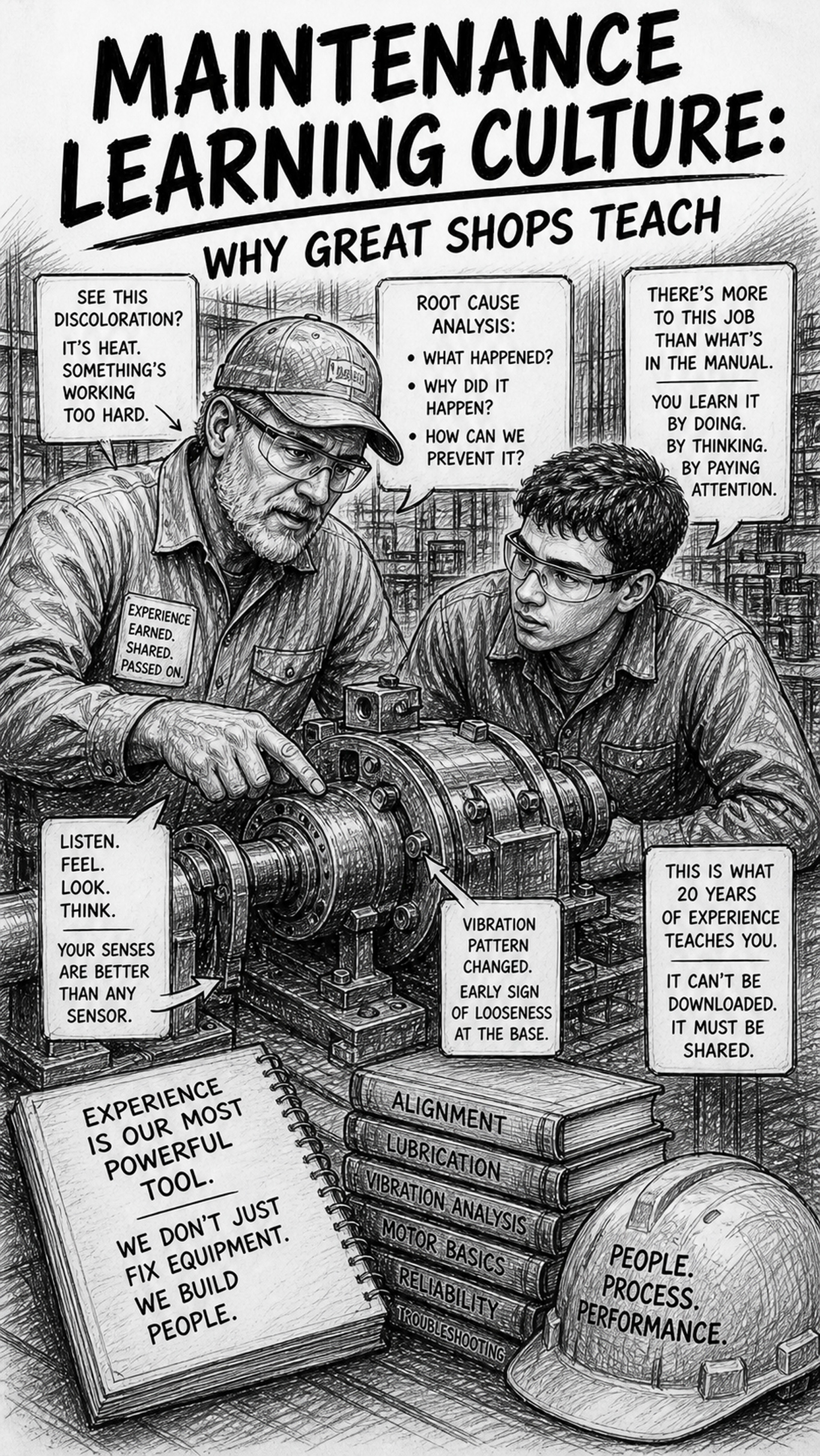
Every maintenance organization has seen it. One person becomes the expert on a particular machine. Another becomes the only person who understands a specific process. Over time, critical knowledge becomes concentrated in a handful of individuals.
Sometimes this happens unintentionally, and sometimes people protect knowledge because it provides job security, influence, or status. Regardless of the reason, the result is the same. The organization becomes dependent on individuals instead of systems.
Strong maintenance learning cultures work in the opposite direction. Their goal is not to create experts that everyone depends on. Their goal is to multiply expertise across the organization. Knowledge becomes something to share, not something to protect.
Every Day Is a Learning Opportunity
The strongest maintenance teams create environments where learning happens continuously.
A troubleshooting session becomes an opportunity to explain why a failure occurred. A root cause analysis becomes a chance to teach reliability principles. A breakdown becomes a case study that strengthens future decision-making.
Questions are encouraged. Curiosity is respected. Knowledge flows freely between individuals and teams. Most importantly, people are not afraid to admit they don’t know something.
That may sound simple, but it is one of the most important cultural differences between average organizations and exceptional ones. In weak cultures, admitting uncertainty can feel risky. In strong cultures, learning is viewed as professionalism.
Why Mentorship Matters
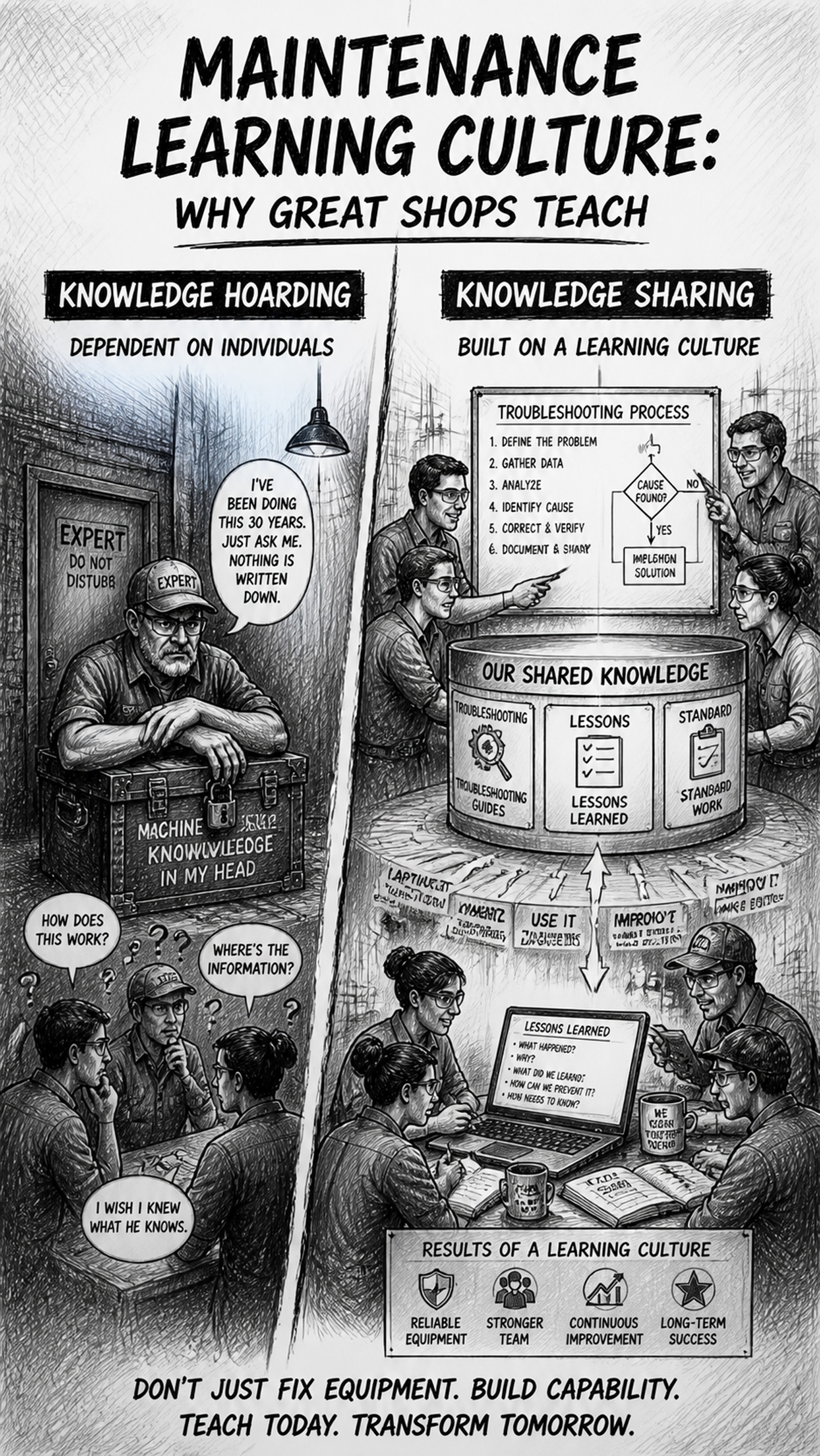
Some of the most valuable knowledge in manufacturing will never appear in a manual. Instead, it lives in the daily observations and experiences of the people closest to the equipment. Experienced technicians learn to recognize unusual sounds during startup, understand how equipment behaves under load, and distinguish between symptoms that matter and those that do not. Over time, they begin spotting failure patterns long before they become breakdowns.
Many of these lessons are learned through years of observation, troubleshooting, and hands-on experience. That is why experienced technicians are far more than skilled tradespeople.
They are educators.
One of the smartest investments a maintenance organization can make is creating opportunities for experienced employees to mentor the next generation. Because retirement does not simply remove labor from a plant. It removes memory.
A technician with thirty years of experience carries thousands of lessons about failure patterns, historical modifications, recurring problems, equipment weaknesses, and reliability insights. Without structured knowledge transfer, much of that experience disappears quietly.
Then the next generation begins relearning lessons that were already paid for years ago.
Preserving What the Organization Learns
A university would never allow decades of knowledge to disappear every time a professor retired. Knowledge is preserved, organized, improved, and passed forward.
Maintenance organizations should think the same way. Every breakdown teaches something valuable, every repair generates information, and every troubleshooting effort creates new understanding.
The real value comes when those lessons are captured and shared across the organization instead of remaining isolated to one person, one shift, or one event. The goal is not simply to store information, it is to make knowledge accessible when people need it most.
That is where maintenance learning culture begins creating long-term value.
Learning Creates Adaptability
Technology will continue transforming manufacturing.
Automation will expand. AI-assisted diagnostics will become more common. Predictive maintenance systems will improve. Digital tools will become increasingly sophisticated.
The maintenance teams that struggle in the future will not necessarily struggle because of technology.
They will struggle because they never built learning cultures.
Organizations that embrace continuous learning adapt more easily to change. They absorb new technologies faster, they solve problems more effectively, and they develop stronger technical capabilities and build confidence throughout the workforce.
Learning creates flexibility, and flexibility creates resilience.
Developing More Than Technical Skills
One of the biggest benefits of a strong maintenance learning culture is that it develops more than technical competence. It develops confidence.
Younger technicians become more willing to take ownership. Teams collaborate more effectively. Problem-solving becomes more structured. Knowledge becomes embedded within the organization instead of residing inside a few individuals.
People begin feeling that they are growing professionally rather than simply surviving shift to shift. That matters.
The best technicians are not only looking for employment. They are looking for development, and they want to work in environments where skills are respected, knowledge is shared, experience is valued, and learning is encouraged.
Organizations that fail to create those conditions will increasingly struggle to attract and retain strong technical talent.
Great Shops Develop People
The future maintenance department cannot function only as a repair service. It must function as a learning system. A place where knowledge is continuously created, refined, documented, shared, and transferred across generations of employees.
Because machines are only part of what maintenance organizations maintain. They also maintain capability.
And the organizations that invest most seriously in learning will ultimately build the strongest reliability cultures, the strongest technical teams, and the strongest operational futures.
Because great maintenance shops do not only repair equipment. They develop people.
If you enjoy practical discussions about maintenance learning culture, reliability, leadership, and operational excellence, connect with me on LinkedIn. I’d be happy to continue the conversation there.