Walk into almost any manufacturing plant today and you’ll hear the same statement, usually with a sense of pride: ‘We have a CMMS.
And honestly, that’s a good thing. Over the last few decades, maintenance organizations have invested heavily in computerized maintenance management systems. Work orders are tracked, preventive maintenance schedules are organized, spare parts are catalogued, downtime is recorded, and reports can be generated in seconds. Most plants have accumulated years of maintenance history inside their systems, creating an impressive database of information.
But here’s a question that doesn’t get asked often enough. When a technician is standing in front of a failed machine at two o’clock in the morning, does the CMMS actually help them solve the problem faster? In many organizations, the honest answer is no. That doesn’t mean the CMMS has failed. It simply means there is a significant difference between storing maintenance data and creating maintenance intelligence. Most systems do an excellent job of documenting activity. They tell us what happened, when it happened, and often who performed the repair. What they don’t always capture is what the technician learned during the process.
And that’s where the real opportunity exists.
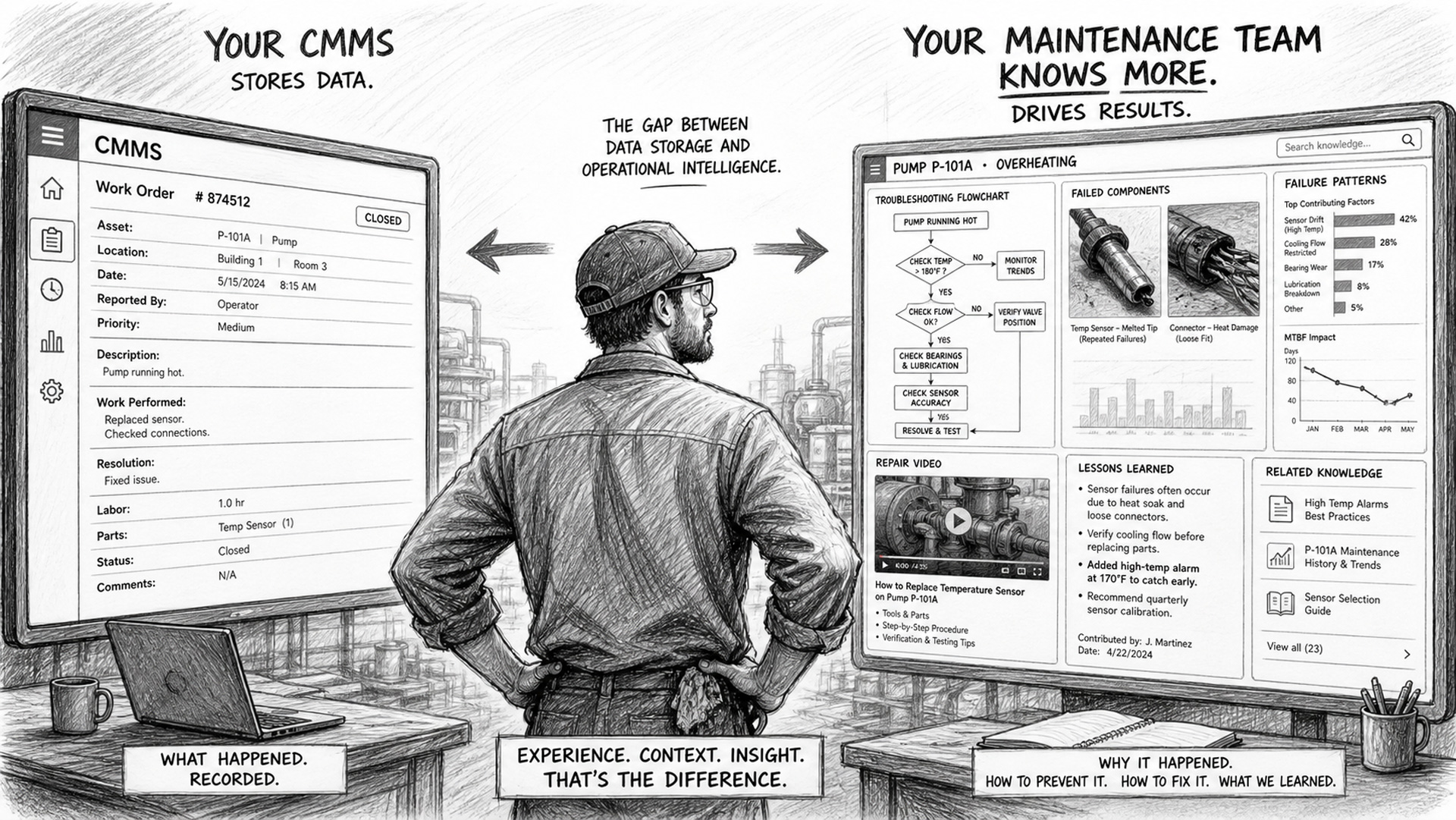
Your CMMS Knows What Happened
Maintenance excellence is not built on historical records alone. It is built on operational knowledge, the practical understanding of how equipment behaves, how failures develop, and how experienced technicians diagnose problems in the real world.
Think about the people in your maintenance department. Every plant has someone who seems to know a machine inside and out. They recognize subtle changes in performance before alarms appear. They remember similar failures from years ago. They can often identify the source of a problem long before the data points in a report begin to tell the story.
That knowledge is incredibly valuable. The challenge is that very little of it actually lives inside the CMMS. Instead, it lives inside people. You see this knowledge in the technician who knows a conveyor typically starts showing symptoms hours before a coupling fails. An electrician may recognize that a particular sensor becomes unreliable during temperature swings. A mechanic might identify a failing bearing by sound long before vibration analysis confirms the issue. Much of this practical knowledge is developed through years of observation on the floor. It’s one of the reasons I believe Gemba remains one of the most valuable tools in manufacturing leadership.
Those insights keep equipment running, but they’re often difficult to transfer to the next generation of technicians. That’s one reason many organizations are exploring ways to preserve expertise before it disappears. In a previous article, I discussed what happens when critical maintenance knowledge leaves with experienced employees and why every plant should think about what happens when its best technician never really leaves.
The Knowledge Gap Most Plants Ignore
Take a look at a typical work order history. You’ll often find entries like ‘Replaced sensor’, ‘Adjusted chain’, ‘Reset overload’, or ‘Motor replaced’.
The repair was documented. The learning wasn’t. Which symptoms appeared first? What troubleshooting path led to the diagnosis? How was the failure confirmed? And what should the next technician look for if the same issue appears again?
These are the details that matter when production is down and every minute counts. Yet they’re often missing from the system because most organizations focus on documenting activity rather than capturing experience. As a result, a plant can accumulate years of maintenance history and still struggle with the same recurring failures. The organization captured data, but it never captured learning.
And those are two very different things.
The Difference Between Data and Maintenance Intelligence
Imagine two maintenance departments facing the same equipment failure. In the first, a technician opens the CMMS and reviews previous work orders. They can see what repairs were completed, but they have very little insight into how those repairs were diagnosed or why certain decisions were made.
In the second, the technician accesses a knowledge platform that includes common failure symptoms, troubleshooting guides, photos of failed components, repair videos, root cause findings, lessons learned, and recommendations from previous repairs.
Both systems contain information. Only one helps people make decisions. That’s the difference between maintenance data and maintenance intelligence. One records history. The other improves performance.
Once organizations understand that distinction, they begin looking at their maintenance systems very differently.
Why Technicians Trust Experience More Than Data
Most experienced tradespeople don’t trust a system simply because it contains information. They trust a system when it helps them solve problems. A technician doesn’t care how many records exist in a database if those records don’t help identify the root cause of a failure. What matters is whether the system provides useful guidance under real production pressure.
Can it help narrow the diagnosis? Will it reduce troubleshooting time? Does it prevent someone from repeating the same mistake? When the answer is yes, trust grows quickly.
That’s why tribal knowledge remains so powerful in many organizations. Technicians trust experience because experience consistently helps them make better decisions. The challenge for modern maintenance leaders is finding ways to capture that experience and make it accessible to everyone.
Maintenance Is a Learning Function
We often think of maintenance as a technical function, but it’s really a learning function as well. Every breakdown teaches something, every repair creates experience, and every troubleshooting effort generates operational insight. The problem is that many organizations lose that learning as soon as the work order is closed, forcing teams to solve the same problems repeatedly.
Documentation alone isn’t enough. Organizations need to capture the thinking behind the repair, not just the repair itself. In the same way that Leader Standard Work creates consistency in leadership behaviours, maintenance intelligence creates consistency in troubleshooting and repair execution. They need to preserve the context, the reasoning, the diagnostic process, and the practical field experience that allowed someone to solve the problem in the first place.
That’s the missing layer between CMMS data and true maintenance intelligence.
The Future Belongs to Organizations That Capture Knowledge
Perhaps the most important realization is this: your maintenance team already knows more than your CMMS. The challenge isn’t creating knowledge, the challenge is capturing it, organizing it, and making it available at the exact moment someone needs it. Just like Daily Management, maintenance intelligence depends on making important information visible and accessible when decisions need to be made.
The future maintenance department won’t win because it has the largest database. It will win because it has the most usable knowledge. The organizations that thrive will be the ones that transform experience into accessible guidance, allowing technicians to learn faster, troubleshoot more effectively, and make better decisions under pressure. The best organizations don’t treat knowledge retention as a side project. They make it part of their strategy. Which is exactly where a system like Hoshin Kanri can help align workforce capability with long-term business goals. Because in the end, a work order history can never replace experience.
But a well-designed maintenance intelligence system can make that experience available to everyone. And that’s when maintenance stops relying on a handful of experts and starts building expertise across the entire organization. That’s when maintenance becomes more predictable, more reliable, and far more resilient. That’s when maintenance becomes truly intelligent.
I regularly share thoughts on maintenance, reliability, leadership, and continuous improvement on LinkedIn. If those topics interest you, I’d be happy to connect with you there.