When Experience Walks Out the Door
For decades, factories have depended heavily on human memory. Think about the experienced operator who remembers how the line behaved before a major failure, the electrician who knows which drive faults tend to appear during humidity changes, or the mechanic who can identify an alignment issue simply by listening to a machine during startup.
Manufacturing has always relied on experience. Yet hidden inside that reality is a challenge that nearly every organization faces. Human memory leaves. People retire, transfer, or simply move on. Along the way, they take decades of operational learning with them. Every retirement, transfer, or departure removes valuable experience that organizations often spend years rebuilding. And every time that happens, factories lose part of their intelligence.
For years, companies tried solving this problem through procedures, manuals, work orders, and maintenance records. Unfortunately, most of those systems were designed to document activity rather than preserve operational understanding.
As a result, many factories continue repeating the same failures, relearning the same lessons, and rediscovering the same problems over and over again. The strongest organizations recognize that preserving and transferring knowledge is just as important as maintaining equipment.
But this is beginning to change. The future factory will not only automate production. It will remember experience. And that may become one of the most important transformations manufacturing has ever seen.
Beyond Data: Building Digital Memory
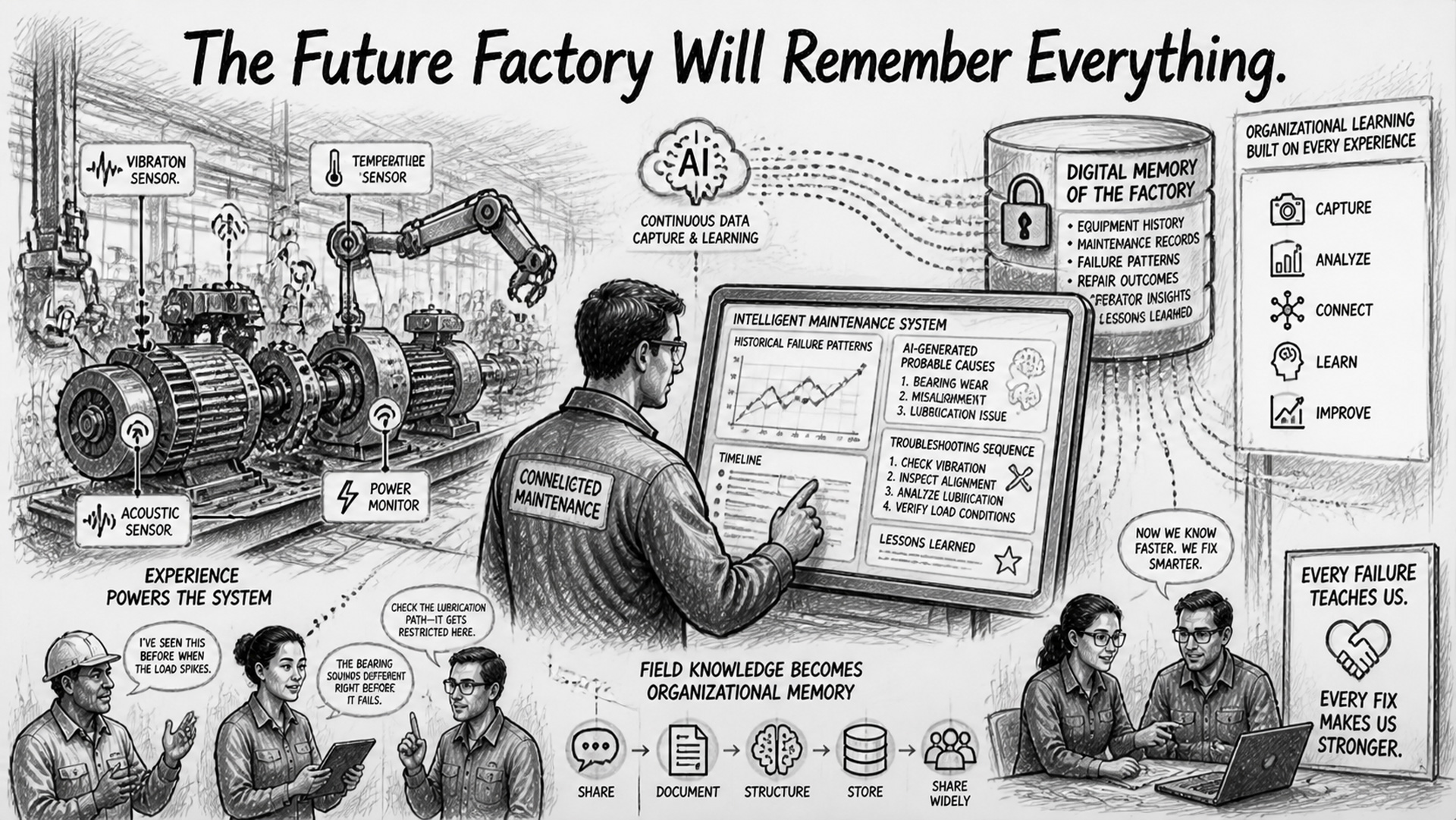
The factories of the future will develop what can best be described as digital memory: the ability to continuously capture, organize, learn from, and reuse operational knowledge across the organization. Not just machine data. Operational intelligence.
There is a major difference between the two.
Modern factories already generate enormous amounts of information. Temperatures, pressures, vibrations, downtime history, alarm logs, sensor readings, and production metrics are collected every second of every day.
But data alone does not create intelligence. Intelligence emerges when information gains context, meaning, patterns, and learning. The challenge is no longer collecting information. The challenge is turning information into decisions that improve reliability and operational performance.
That is where the future factory begins to separate itself from traditional manufacturing environments.
A Different Kind of Troubleshooting
Imagine a maintenance technician responding to a packaging line fault ten years from now.
Instead of starting from scratch, the technician accesses an intelligent maintenance ecosystem that instantly provides historical failure patterns, probable causes, similar breakdowns from other facilities, recommended troubleshooting sequences, previous repair outcomes, real-time equipment condition analysis, and lessons learned from earlier interventions.
The system does not simply store maintenance history. It actively supports decision-making. This is where AI-assisted troubleshooting becomes transformational. Artificial intelligence will not replace skilled tradespeople. The idea that technology alone can replace maintenance expertise misunderstands how manufacturing truly operates. What AI will do is amplify human capability. It will help technicians recognize patterns faster, reduce uncertainty, accelerate root cause identification, and make operational knowledge accessible across the entire organization.
In many ways, future AI systems will function like highly experienced technical advisors that never forget previous failures.
Turning Experience Into Organizational Learning
Imagine a system capable of recognizing that a slight increase in motor current combined with intermittent temperature spikes historically led to gearbox failure within three weeks. Or that a particular vibration signature consistently appeared before conveyor shaft misalignment. Or that specific fault combinations tend to occur after lubrication contamination. That is not simple data storage. That’s organizational learning.
Today, many factories collect information but struggle to convert experience into reusable intelligence. A breakdown occurs, repairs are completed, production restarts, and the learning disappears into disconnected work orders, emails, spreadsheets, or individual memory.
The future factory will treat every operational event as a learning opportunity. Every failure, repair, adjustment, unusual operating condition, and troubleshooting process becomes an opportunity for learning. The system learns continuously, but more importantly, so does the organization. Every failure contains information, but only organizations that capture and share those lessons create lasting improvement.
The New Role of Maintenance
This shift changes the role of maintenance entirely.
Maintenance will no longer function only as a repair organization. It will become an operational intelligence system deeply connected to reliability, production performance, engineering improvement, and predictive decision-making.
Future maintenance teams will spend less time reacting to failures and more time preventing them.
Machines themselves will increasingly participate in this ecosystem. Equipment will continuously monitor its own condition through sensors, analytics, thermal imaging, vibration monitoring, and machine-learning algorithms capable of identifying unusual operating conditions long before catastrophic failure occurs.
Yet technology alone is not the breakthrough.
The real breakthrough happens when machine intelligence combines with human experience.
Why Human Expertise Still Matters
Even the most advanced systems benefit enormously from practical field knowledge.
Some of the most valuable insights come from experience. Technicians learn how a machine sounds under load, understand how operators experience unusual equipment conditions, and recognize when a temporary fix may create a larger problem later. Over time, they also learn which failure patterns tend to repeat seasonally and which operating conditions accelerate wear.
Some of the most valuable reliability insights still come from the people closest to the equipment. The future factory will integrate both worlds. Digital intelligence. Human intelligence.
Together, they will create maintenance ecosystems capable of learning and evolving continuously over time.
In these environments, operators become equipment observers. Technicians become knowledge contributors. AI systems become pattern-recognition engines. Maintenance databases become learning platforms. Failures become opportunities for improvement.
The factory develops a form of organizational memory that survives beyond individuals, shifts, departments, and even generations of employees.
Technology Alone Is Not Enough
There is, however, an important warning hidden inside this vision of the future. Technology alone will not create intelligent factories.
Many organizations will invest heavily in sensors, dashboards, AI platforms, and digital tools while continuing to operate with reactive cultures, weak documentation practices, poor communication, and fragmented knowledge systems.
A factory cannot become intelligent if its knowledge remains disconnected. Digital transformation without operational learning simply creates faster confusion.
The factories that truly succeed will understand that smart manufacturing is not only about automation.
Success depends on accessible knowledge, turning experience into systems, and ensuring that every lesson learned strengthens the organization permanently.
And perhaps for the first time in industrial history, factories will no longer depend entirely on whether one experienced person happens to be present during a breakdown.
Because the future factory will remember.
Everything.
If you enjoy practical discussions about maintenance, reliability, leadership, operational excellence, and the future of manufacturing, connect with me on LinkedIn. I’d be happy to continue the conversation there.