For many years, maintenance success in manufacturing was measured by one simple question: How fast can you get the machine running again?
At one time, that mindset made perfect sense. Production stops were visible, expensive, and disruptive. Maintenance teams became highly skilled at responding under pressure, and the technicians who could restore equipment the fastest often became the heroes of the plant.
Most of us have worked in environments like that. A critical machine goes down, production starts asking questions, leaders want updates, and all attention shifts toward getting the line running again.
The repair becomes the priority. In that moment, getting the machine running again feels like the only thing that matters. But there is an important question that modern manufacturing organizations need to ask themselves: Are we fixing equipment, or are we improving reliability? The distinction matters because those are not the same thing.
A plant can become exceptionally good at repairing failures and still struggle with instability. The same breakdowns continue to occur, emergency work fills the schedule, and stress slowly becomes part of the culture. Production moves from one crisis to the next, and everyone becomes very good at reacting.
The organization becomes efficient at recovery, but not necessarily effective at prevention. In many cases, the biggest losses don’t come from the repair itself. They come from the delays, uncertainty, and inefficiencies that surround the breakdown. That’s exactly why a simple repair can sometimes turn into hours of lost production.
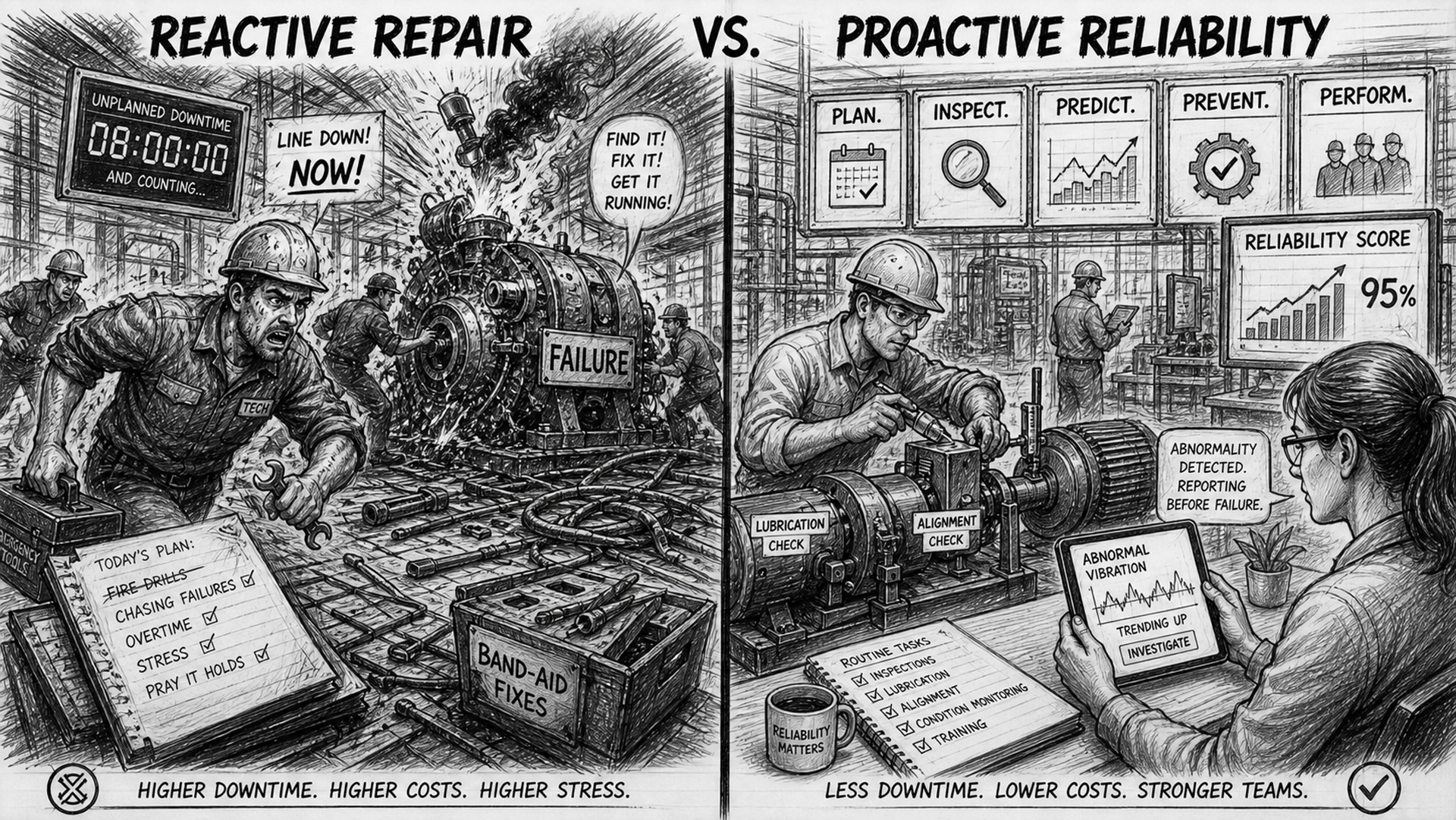
The Difference Between Repair and Reliability
At its core, reactive maintenance focuses on restoring operation after a failure occurs.
Improving reliability focuses on reducing the likelihood of that failure occurring in the first place.
The difference sounds small when you say it out loud, but it changes almost everything about how maintenance organizations operate. It changes how work is prioritized, how people are developed, how data is used, and ultimately how success is measured.
In a reactive environment, urgency drives decision-making. When equipment fails, technicians focus on diagnosis and recovery. Supervisors want estimated restart times. Operations needs updates. Temporary solutions often become acceptable because production must resume as quickly as possible.
To be fair, every organization will experience reactive work. No plant completely eliminates breakdowns.
The problem appears when reactive work becomes the dominant operating model.
When Heroics Become the Standard
Over time, highly reactive organizations can begin to confuse heroics with excellence.
The technician who repeatedly saves the day becomes celebrated. The team that responds fastest to emergencies earns recognition. The ability to recover from failure becomes the primary measure of success.
But there is another question that often gets overlooked: Why does the same failure keep happening?
When maintenance teams spend most of their time responding to emergencies, important activities begin to suffer. Planning becomes weaker. Preventive maintenance gets postponed. Root cause analysis becomes rushed or skipped entirely. Knowledge capture disappears. Continuous improvement takes a back seat to immediate survival.
The result is a cycle that feeds itself. More failures create more emergencies, and more emergencies leave less time for improvement.
Eventually, the organization becomes trapped in firefighting mode.
What Improving Reliability Really Means
Organizations focused on improving reliability think differently. They understand that every failure contains information. A breakdown is not simply an event that needs to be repaired. It is evidence that something within the system allowed equipment deterioration to develop unchecked.
Instead of asking, ‘How do we repair this quickly?’ they begin asking, ‘Why did this happen, and how do we reduce the chance of it happening again?’
That shift changes maintenance from a repair function into a reliability function. The focus moves beyond restoring operation and toward improving asset health.
Looking Beyond the Failure
Consider something as common as a failed bearing. In a reactive environment, the objective is straightforward. Replace the bearing, restart the equipment, and return production to normal.
A reliability-focused organization looks deeper. Why did the bearing fail? Was lubrication adequate? Did alignment contribute to the problem? Could contamination have been present? Were vibration levels increasing before failure? Was installation performed correctly? And finally, is there an operating condition that continues to shorten bearing life?
One approach fixes the symptom. The other improves the system. This is where improving reliability begins to create long-term value. The goal is not simply to repair equipment. The goal is to understand the conditions that allowed failure to develop and then remove those conditions whenever possible.
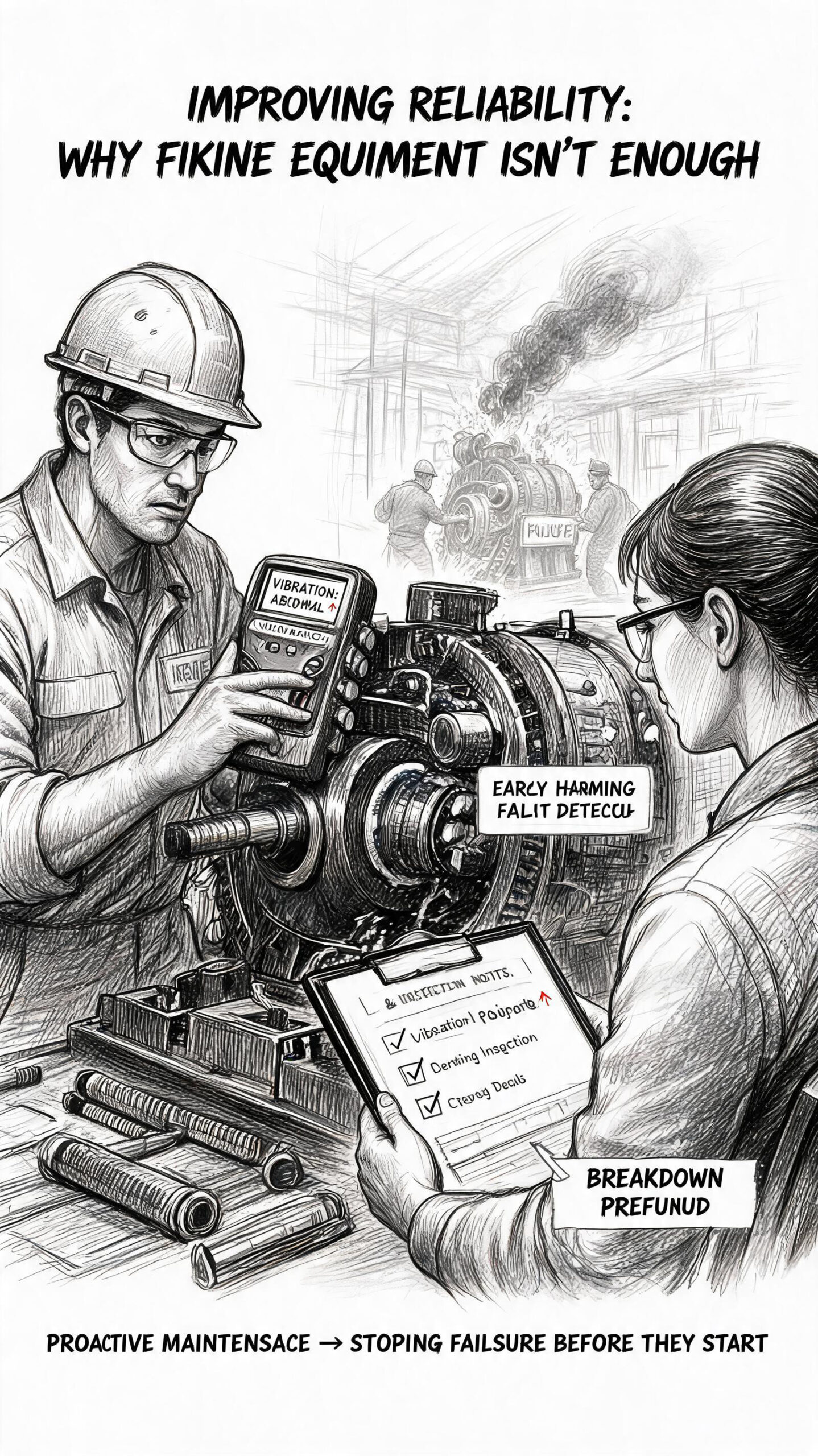
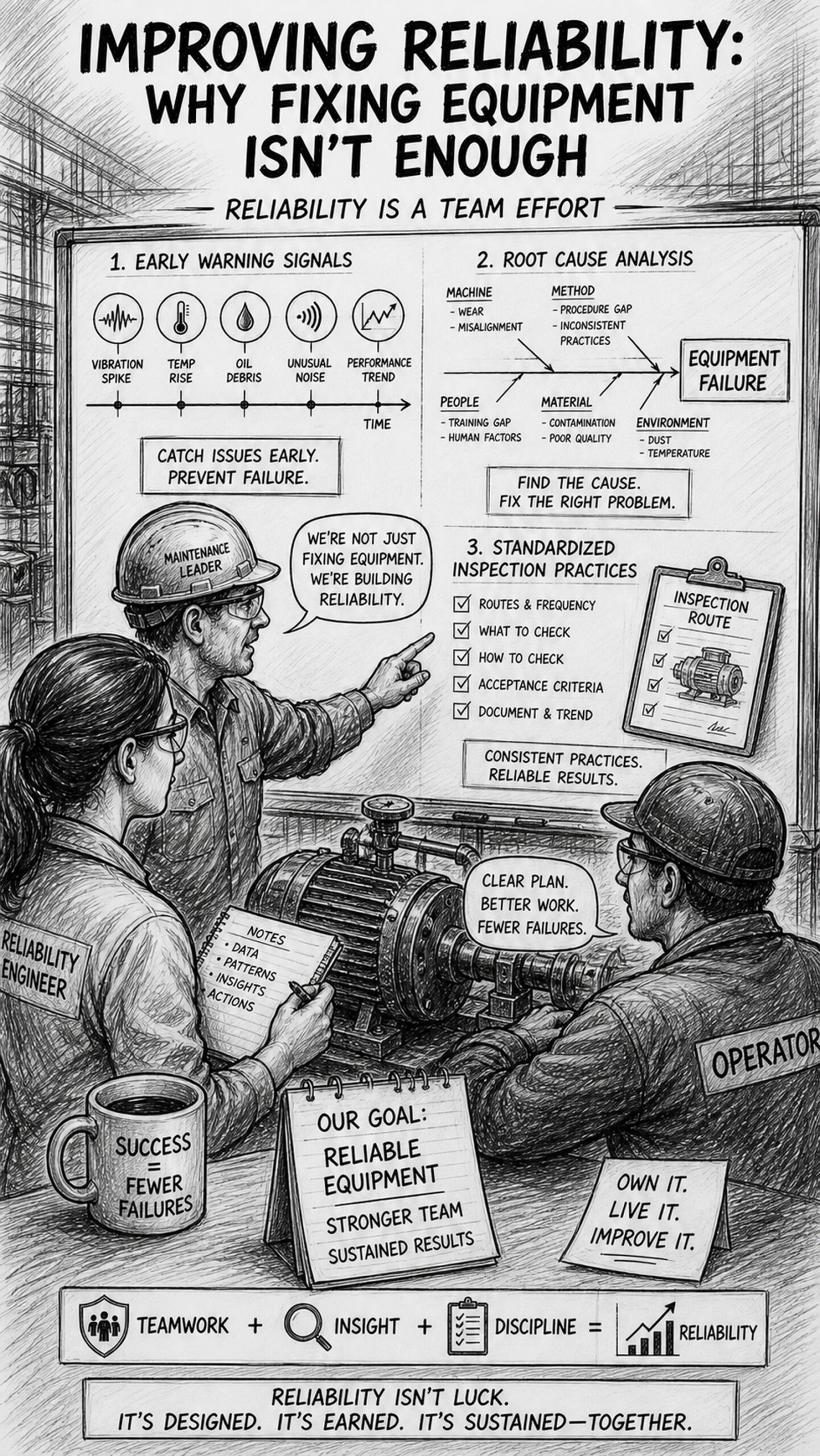
Reliability Work Is Often Invisible
One of the challenges with improving reliability is that the work is usually much less dramatic than emergency repairs.
A successful breakdown recovery is easy to see. The machine starts running. Production resumes. Everyone feels immediate relief.
Reliability improvement is usually much quieter. It happens through better planning, stronger inspections, improved lubrication practices, better alignment procedures, clearer standards, stronger training programs, more effective communication, and better knowledge systems.
Most of the time, nobody celebrates these activities. Yet they often create far more value than the repair itself. The strongest manufacturing organizations are not necessarily the ones with the fastest emergency response teams. They are the ones where emergencies become increasingly rare because equipment deterioration is managed proactively.
What Equipment Is Trying to Tell Us
This shift also changes the role of data inside maintenance organizations.
In reactive environments, maintenance history is often used primarily for reporting. Teams document failures, close work orders, and move on to the next issue.
Organizations focused on improving reliability use data differently. Instead of simply documenting failures, they study failure patterns, identify recurring issues, and look for trends. The goal is to evaluate preventive maintenance effectiveness, uncover weak points, and improve asset performance throughout the equipment lifecycle.
The question changes from ‘What failed?’ to ‘What is the equipment trying to tell us?’ Organizations that ask better questions usually make better decisions. The goal is no longer to collect more maintenance data. The goal is to turn information into actionable insight that supports reliability improvement.
That mindset opens the door to condition monitoring, predictive maintenance technologies, and maintenance intelligence systems. These tools are valuable not because technology solves reliability problems by itself, but because they help organizations recognize failure development earlier.
Reliability Begins Before Breakdown
One of the most important lessons in maintenance is that reliability begins long before a machine stops running. Most failures provide warning signs long before production feels the impact. The challenge is recognizing those signals early enough to act before a breakdown occurs.
Equipment rarely fails without warning.
Temperatures increase gradually, vibration patterns change, lubrication conditions deteriorate, and cycle times begin to drift. Operators notice unusual behaviour, technicians start seeing patterns, and fault frequency slowly increases long before production feels the impact. Many of the earliest warning signs never appear in reports or dashboards. They are observed by the people working with the equipment every day, often long before the system records a fault.
Machines usually communicate before they fail. The difference is how organizations respond to those signals. Reactive cultures often ignore them until production stops.
Organizations committed to improving reliability treat unusual operating conditions as opportunities for intervention. They understand that the earlier a problem is identified, the more options exist to address it safely, efficiently, and economically.
Reliability Is a Team Effort
Reliability is not solely the responsibility of maintenance. It requires collaboration across the organization.
Operators become equipment observers, while technicians become reliability partners. Engineers focus on improving systems, and leaders support long-term thinking instead of focusing exclusively on short-term recovery.
This is one reason practices like Gemba, Daily Management, and Leader Standard Work are so important. They create visibility around equipment health, make abnormal conditions easier to identify, and ensure that reliability concerns become part of everyday conversations instead of waiting for the next breakdown. More importantly, they create the discipline needed to follow up consistently before small issues become major failures.
Reliability is not created by one department.
It is created by a system.
Redefining Success
Perhaps the biggest change involved in improving reliability is how success gets defined. In reactive environments, success often sounds like this: ‘We fixed it fast.’ In reliability-focused organizations, success sounds different: ‘It failed less often.’
That shift may appear simple, but culturally it can be one of the most difficult transitions a manufacturing organization makes. Reactive environments reward urgency, while reliability-focused environments reward discipline. In many plants, firefighting becomes something to celebrate. Reliability cultures take a different approach and place greater value on prevention.
The questions leaders ask also change. Reactive maintenance asks, ‘How quickly can we recover?’ Improving reliability asks, ‘How intelligently can we operate?’
The organizations that truly understand this difference begin transforming maintenance from a cost center into one of the most important drivers of operational stability, production performance, and long-term manufacturing excellence. Because at the highest level, maintenance is not really about repairing machines.
It is about creating the conditions where machines fail less often, perform more consistently, and operate predictably over time. That is the real difference between fixing equipment and improving reliability.
If you enjoy practical discussions about maintenance, reliability, leadership, and operational excellence, connect with me on LinkedIn. I’d be happy to continue the conversation there.