Walk into almost any manufacturing plant during a major breakdown and you’ll notice something interesting.
Everyone suddenly becomes focused on troubleshooting. Maintenance is called urgently. Production wants updates. Leaders ask when the line will be running again. Technicians gather around the equipment and begin searching for answers.
The problem is that troubleshooting should have started long before this moment. By the time production stops, the conversation has already changed. The focus is no longer on understanding the failure early. It becomes about urgency, recovery, and getting the equipment running again as quickly as possible.
The machine didn’t fail suddenly. The organization simply reacted late.
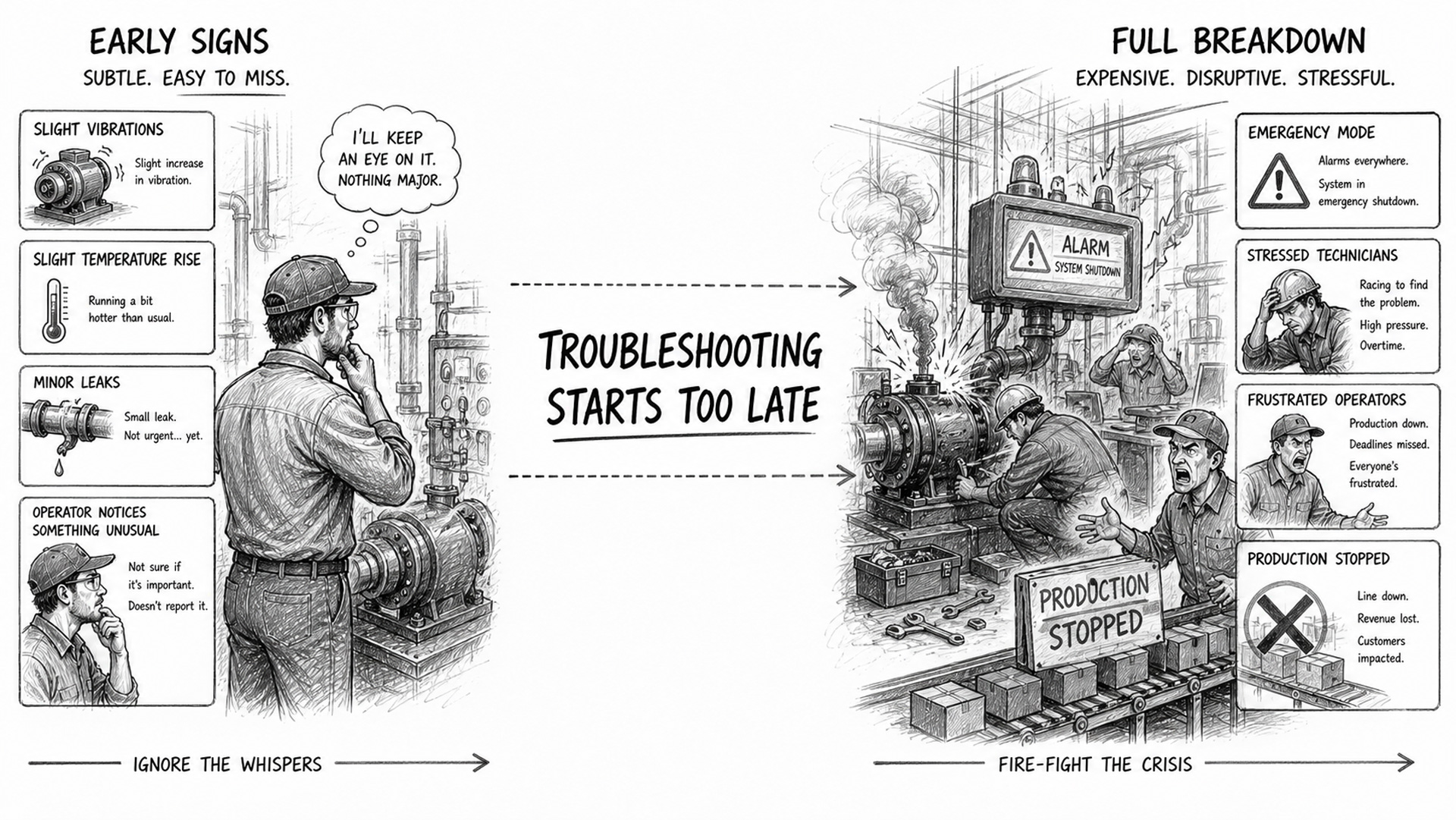
Equipment Usually Whispers Before It Screams
One of the biggest misconceptions in maintenance is the belief that failures happen without warning.
Most don’t. Long before equipment stops running, it usually begins communicating that something isn’t right. Machines vibrate differently. Temperatures slowly increase. Small leaks appear. Cycle times drift. Minor jams become more frequent. Faults begin occurring more often. Operators notice unusual behaviour and technicians start seeing patterns that weren’t there before. In other words, equipment usually whispers before it screams.
This is one of the reasons why Gemba remains such a powerful leadership practice. The earlier we observe equipment behaviour where the work actually happens, the sooner we can recognize abnormal conditions before they become failures.
The challenge is that many organizations never build a structured system for recognizing those early signals.
When ‘Later’ Becomes a Breakdown
In highly reactive environments, a familiar mindset often develops: ‘If it’s still running, we’ll deal with it later.’ It sounds reasonable in the moment. Production targets need to be met. Resources are limited. The equipment is technically still operating.
But later usually arrives at the worst possible time. It arrives during a critical production run. It arrives on a night shift. It arrives when key resources are unavailable. It arrives when the consequences are highest. Then the plant shifts into emergency mode.
Maintenance begins troubleshooting under pressure instead of under control, and that changes everything.
Why Troubleshooting Quality Changes Under Pressure
When troubleshooting begins too late, the objective often changes.
The conversation shifts from ‘What is the real failure mechanism?’ to ‘How quickly can we get it running again?’ That difference matters.
Under pressure, teams naturally focus on restoring operation as quickly as possible. Temporary fixes become permanent solutions. Components get replaced without fully understanding why they failed. The same failures return because the organization never had the opportunity to learn from the original event.
The breakdown gets fixed. The problem remains.
Predictive Maintenance Starts with Awareness
When people hear the term predictive maintenance, they often think about sensors, vibration analysis, thermal imaging, or artificial intelligence.
Those technologies are valuable. But predictive maintenance begins much earlier than most people realize. It begins with awareness.
Some of the most important sensors in a manufacturing plant are still human beings. Operators hear changes. Technicians notice patterns. Mechanics recognize vibration behaviour. Electricians identify unstable signals before they trigger alarms.
Much of this practical knowledge never appears in a work order history, which is why many organizations are discovering that their maintenance teams often know more than their CMMS. Experienced tradespeople develop an instinct for machine behaviour that software alone cannot always replicate. Preserving that instinct and making it available to future technicians is exactly why many organizations are investing in structured maintenance knowledge systems.
The question is whether the organization has a system for capturing and acting on that knowledge.
Turning Observations into Action
This is where many plants struggle.
Operators notice something unusual but don’t report it because the machine is still running. Maintenance sees recurring symptoms but lacks a process to escalate concerns before the failure develops further. Consistent escalation rarely happens by accident. It requires the discipline and follow-up routines found in strong Leader Standard Work systems.
As a result, small abnormalities remain isolated observations instead of becoming actionable intelligence. Turning those observations into usable knowledge is one of the foundations of true maintenance intelligence.
Strong Daily Management systems solve this problem by making abnormalities visible. Instead of waiting for breakdowns, teams discuss concerns while they are still manageable.
The goal is simple: identify problems when they are still small enough to control.
Building a Failure Recognition Culture
The best reliability cultures remove the traditional barrier between operations and maintenance.
Operators aren’t expected to become technicians, and maintenance teams aren’t expected to run production equipment. But both groups share responsibility for recognizing equipment deterioration early.
When operators are trained to identify abnormal conditions and maintenance teams respond quickly to concerns, the conversation changes.
Instead of discussing failures, teams start discussing warning signs. And, instead of asking why the machine stopped, they begin asking why the machine’s behaviour changed.
That shift is powerful. Small observations that seem insignificant on their own often become the earliest warning system a plant has.
The Earlier You Intervene, the More Control You Have
Most failures develop in stages. A leaking seal becomes bearing contamination. A slight misalignment becomes coupling failure. An unstable sensor becomes line downtime. A recurring reset becomes motor burnout.
Failures evolve long before they become crises. The earlier an organization intervenes, the cheaper, safer, and faster the correction becomes.
This is why the future of maintenance won’t belong only to plants with the most advanced predictive technologies. It will belong to organizations that develop the strongest failure recognition culture.
Technology can detect signals. Culture determines whether people act on them.
Troubleshooting Should Start Before the Breakdown
The most mature maintenance organizations understand something important.
Troubleshooting should not start after the breakdown. It should start the moment equipment behaviour begins to change. Because the earlier you recognize failure, the more control you have over the outcome.
And in maintenance, control is often the difference between a planned repair and a production crisis.
If you enjoy practical discussions about reliability, maintenance leadership, operational excellence, and continuous improvement, connect with me on LinkedIn. I’d be happy to continue the conversation there.