The Question That Changes Everything
Every time something goes wrong in a plant, the same question usually comes up.
Who is responsible? It’s a natural reaction. We want answers. We want accountability. Most importantly, we want to make sure the same problem does not happen again.
After years in maintenance and manufacturing leadership, however, I’ve learned that there is often a better question to ask first.
Who can help the organization learn the most from this failure? That question changes everything.
Instead of looking backward to assign blame, we start looking forward to create improvement. The conversation shifts from finding fault to understanding causes. People become more willing to share information. The organization becomes more focused on learning than defending.
And that is where real progress begins.
When Blame Becomes the Goal
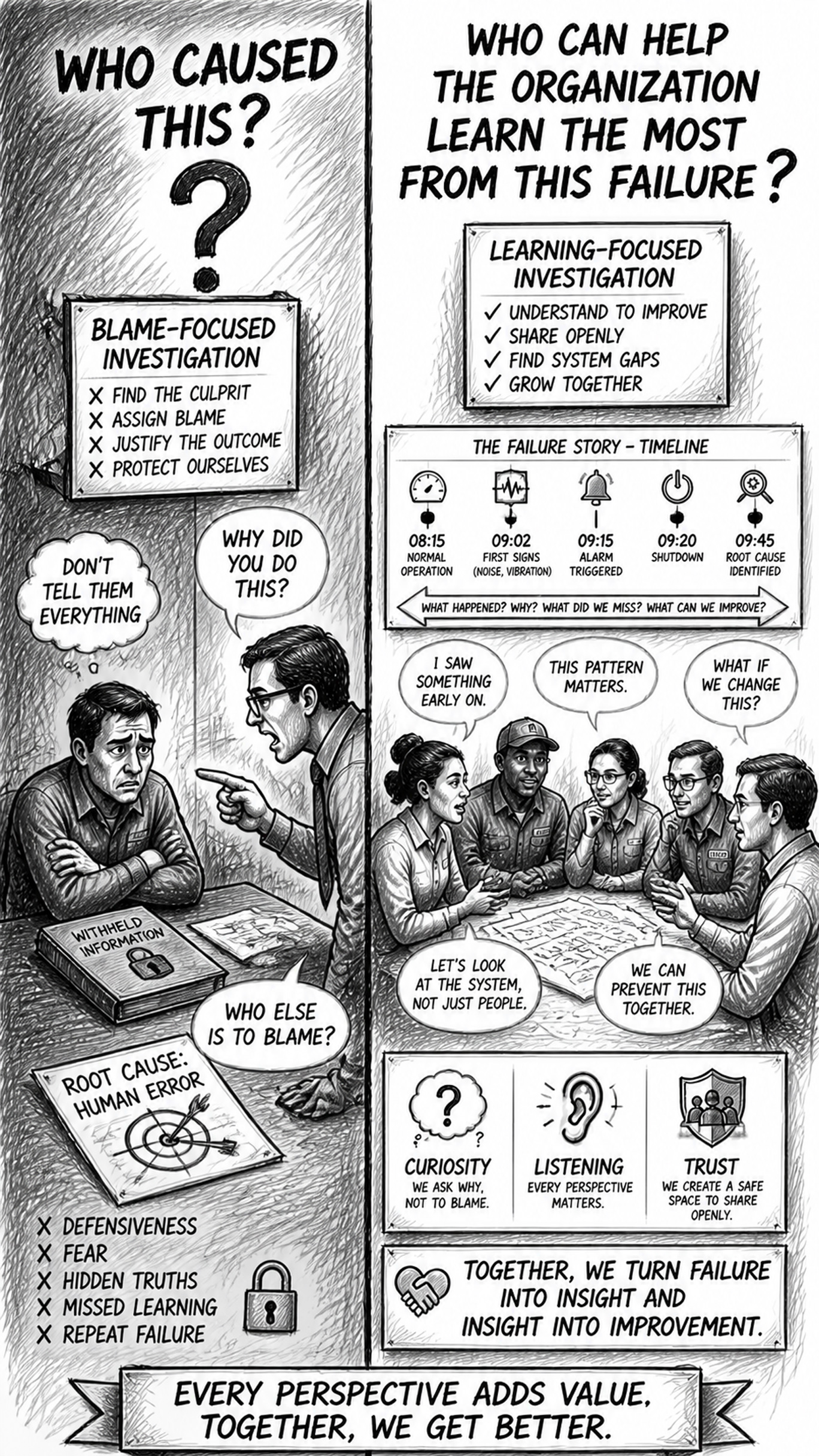
Most investigations start with good intentions. Unfortunately, many of them slowly turn into a search for the person who made the mistake.
Who missed the inspection? Which one approved the work? Who failed to follow the procedure?
The moment people feel blamed, their behaviour changes. They become cautious about what they say. Important details get left out. Conversations become more defensive. Instead of helping the organization understand what happened, people begin protecting themselves.
As a result, the opportunity to learn from failure starts disappearing before the investigation is even complete. This does not mean accountability is unimportant. Accountability matters.
The problem is what comes first. When blame becomes the primary objective, learning usually suffers. When learning comes first, accountability often becomes much clearer because the organization gains a deeper understanding of what actually happened.
Every Failure Has a Story
Machines rarely fail because of a single event. Most failures develop over time. In fact, many organizations become very good at repairing equipment while missing the deeper opportunity to improve reliability and prevent similar failures from happening again.
A bearing may fail after months of poor lubrication. A recurring breakdown may continue because nobody addressed the root cause. A project may struggle because expectations were never clearly defined from the beginning.
What we see on the day of the failure is usually the final chapter. The story started long before that.
To learn from failure, we need to understand the entire sequence of events that led to the outcome. That often starts by going to the place where the work actually happens and observing the reality of the situation firsthand. It requires curiosity. It requires patience. Most importantly, it requires listening. In many cases, the best place to start is by going to the place where the work actually happens. Seeing the process firsthand often reveals details that reports and meetings miss.
The strongest organizations understand that the goal is not simply to explain what happened. The goal is to understand why it happened.
That often starts by going to the place where the work actually happens and observing reality firsthand. Assumptions rarely solve problems. Understanding does.
The Best Answers Are Usually Found Together
Many companies assign investigations to managers, engineers, or supervisors. There is nothing wrong with that. But some of the most valuable insights often come from the people closest to the work.
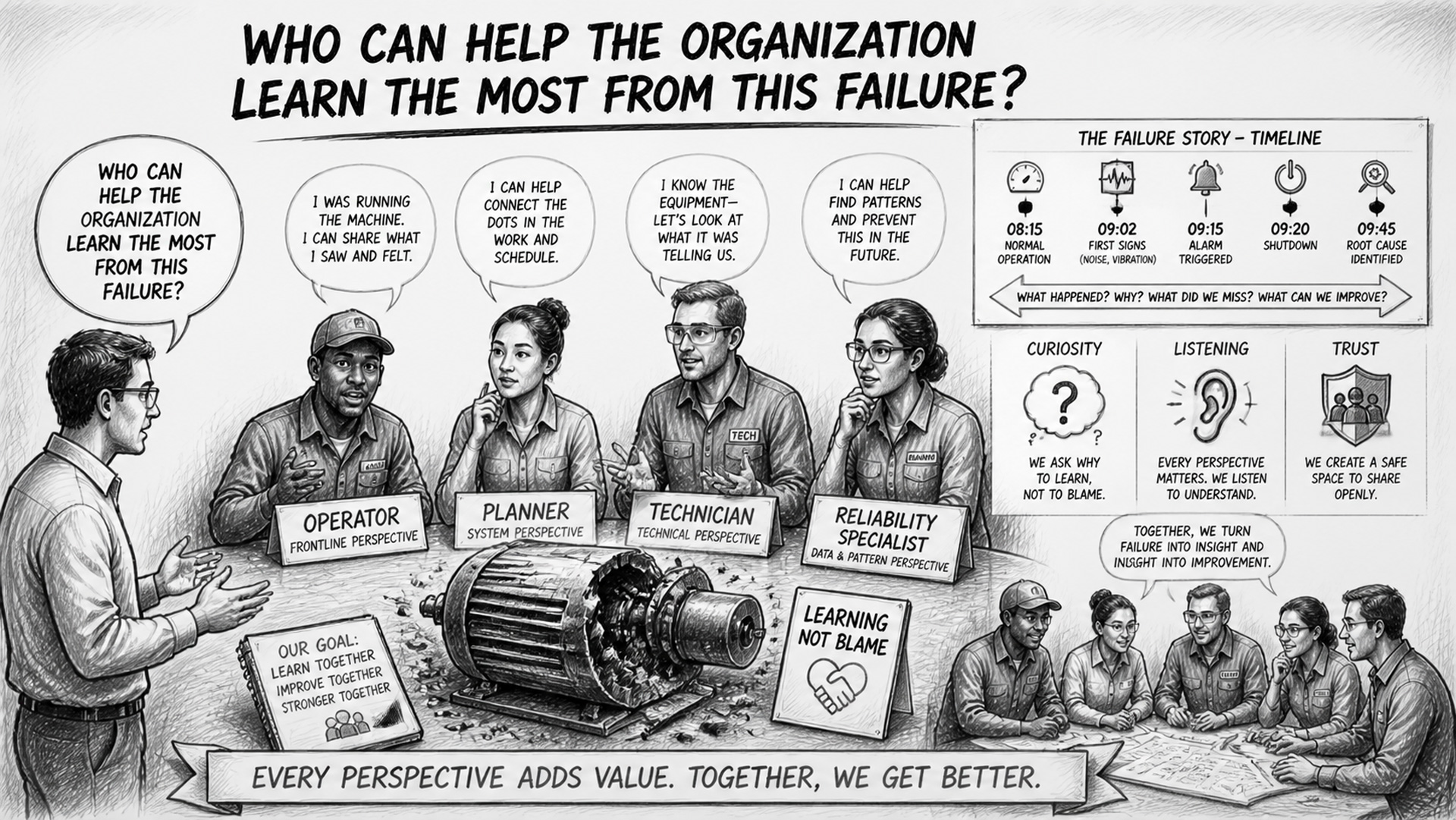
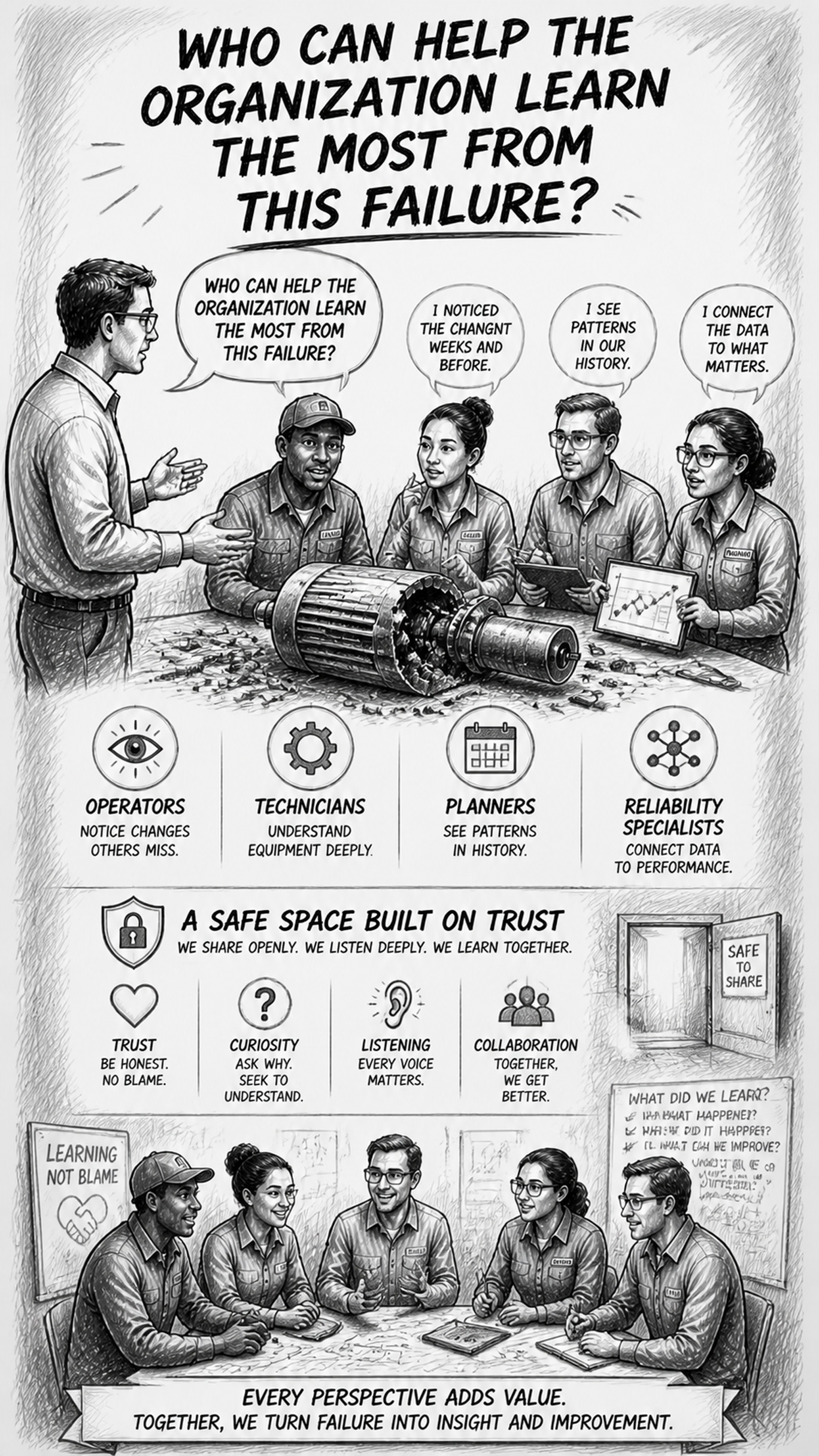
The operator may have noticed unusual behaviour weeks before the failure occurred. A technician may understand the equipment better than anyone else. The planner may recognize patterns hidden inside maintenance history. A reliability specialist may connect information that others overlook.
Each person sees a different part of the picture.
When those perspectives come together, the organization learns from failure much faster. The strongest improvement efforts happen when teams work together to understand the problem before rushing toward solutions.
Titles do not guarantee insight. Curiosity does. Listening does. Collaboration does.
Every Breakdown Comes With a Bill
I often tell my teams that every breakdown arrives with an invoice. We pay in lost production, overtime, emergency parts, delays, frustration, and stress. Whether we like it or not, the organization has already paid for the lesson.
The only question is whether we will learn from failure or waste the opportunity. If the lesson is never captured, the organization will pay again. Learning only creates value when it becomes part of everyday operations instead of remaining inside a report that nobody revisits. In many cases, the next failure costs even more than the first one because the underlying issue remains unresolved.
The best organizations treat failures as investments in knowledge. They do not enjoy failures. They simply refuse to waste them. Every failure creates an opportunity to teach, document, improve, and strengthen the organization for the future. That mindset transforms breakdowns from isolated events into opportunities for continuous improvement.
Learning Requires Trust
People speak openly when they feel safe. They stay quiet when they fear punishment. That is why trust plays such an important role in every investigation. When team members feel respected, they are more willing to share concerns, discuss mistakes honestly, and provide information that might otherwise remain hidden.
The quality of an investigation often depends on the quality of the environment surrounding it. If people trust the process, they contribute. When people fear the process, they withdraw. The difference can be enormous.
Organizations that consistently learn from failure create cultures where people feel comfortable raising concerns before problems become major events. That trust does not appear overnight. It is built through leadership behaviour, consistency, and respect.
The Real Role of a Leader
Many leaders believe their primary responsibility is solving today’s problems. That responsibility certainly matters. But great leaders understand that their role extends beyond today’s issue.
A leader’s job is to make sure the organization becomes smarter tomorrow. That requires more than solving today’s problem. It also requires consistent follow-up, coaching, and visibility around what was learned. That means asking better questions. It also means encouraging honest conversations. It means looking beyond symptoms and searching for causes. It also requires consistent follow-up, coaching, and the discipline to keep learning visible after the immediate problem has been solved.
Most importantly, it means creating a culture where people can learn from failure without fear.
Because the most important question after a breakdown is not ‘Who caused this?’. The most important question is ‘Who can help the organization learn the most from this failure?’. The answer to that question is often the first step toward lasting improvement. And organizations that consistently learn from failure rarely repeat the same lessons twice.
If you enjoy practical discussions about maintenance, reliability, leadership, and operational excellence, connect with me on LinkedIn. I’d be happy to continue the conversation there.