The Waste We Rarely Measure
Lean manufacturing has taught us to recognize many forms of waste. We talk about wasted motion, wasted transportation, wasted inventory, waiting, defects, and overproduction. Teams spend significant time identifying opportunities to reduce these losses because they understand the impact they have on performance.
But there is another form of waste quietly hiding inside many maintenance organizations. The waste of searching for information.
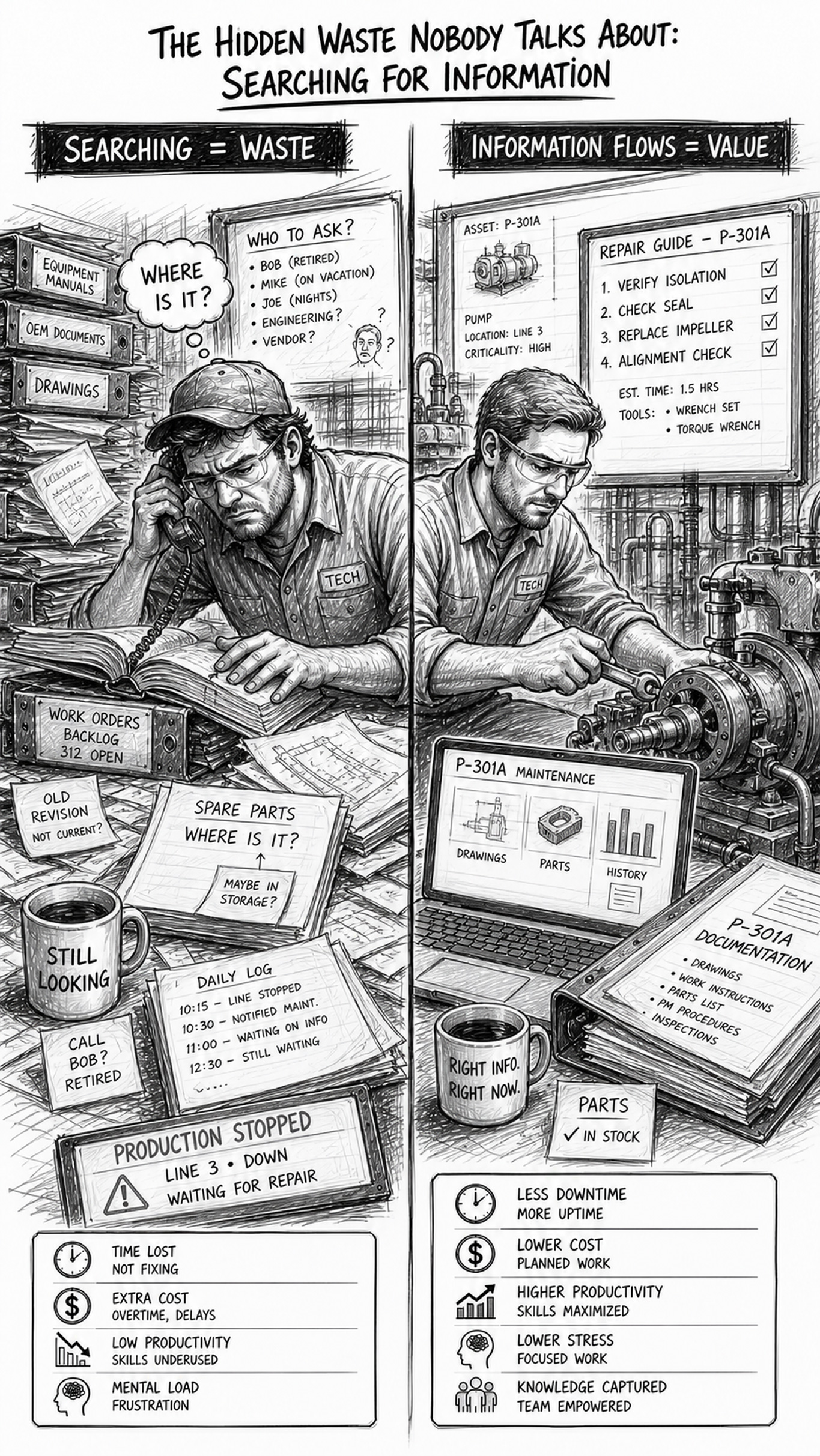
It may not be as visible as a machine breakdown or a production stoppage, but it affects operations every single day. Technicians search for manuals, drawings, troubleshooting instructions, spare parts information, equipment history, vendor contacts, previous repairs, and technical expertise. Individually, each search may only take a few minutes. Collectively, they consume an enormous amount of productive time.
Most plants have simply learned to live with it. They shouldn’t.
Walk through almost any manufacturing plant during a major equipment breakdown and you’ll notice something interesting.
Very often, the biggest delay isn’t the repair itself. It’s everything that happens before the repair even begins. Someone is looking for a manual. Another person is searching for electrical drawings. A technician is trying to remember where a spare part was stored. An operator is calling the person who fixed a similar problem years ago. Meanwhile, production is waiting, downtime is growing, and the clock keeps running.
The actual repair may only take twenty minutes. Getting ready to perform it can take an hour. And yet most organizations barely notice this delay because they’ve accepted it as normal.
The Repair Isn’t the Problem
Imagine a technician responding to a failed conveyor motor. Replacing the motor may only require twenty minutes of actual work. Before that repair can begin, however, the technician may spend time locating the correct electrical drawing, confirming the motor specification, searching for the spare, verifying the gearbox ratio, checking lockout isolation points, and calling another technician for clarification.
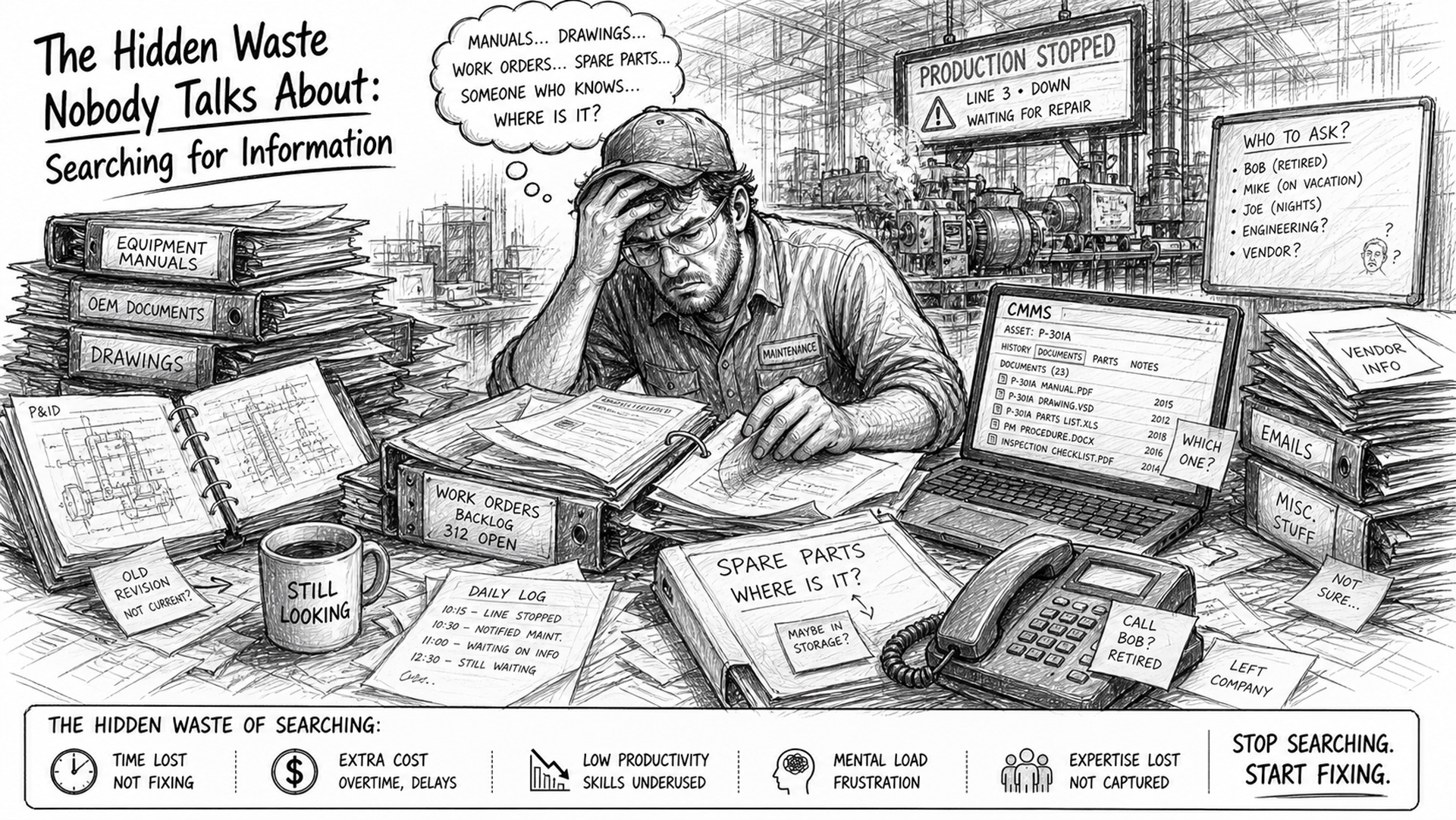
Nothing about the repair itself is inefficient. The system surrounding the repair is. This is a common problem in manufacturing because information is often scattered across filing cabinets, network drives, old binders, spreadsheets, disconnected CMMS notes, emails, and most dangerously of all, people’s memory. When critical knowledge remains trapped inside individuals, organizations risk losing decades of experience when those employees leave or retire.
When critical knowledge remains trapped inside individuals, organizations risk losing years of experience every time someone retires, changes roles, or simply isn’t available when a failure occurs.
When Knowledge Becomes Hard to Find
Maintenance teams don’t usually struggle because they lack information.
Most organizations already possess enormous amounts of knowledge. The challenge is accessibility. Strong Daily Management systems help make critical information visible before it becomes urgent.
Some of the best technicians in manufacturing spend too much of their day acting like detectives instead of technicians. In many cases, the people on the floor possess far more practical knowledge than the systems designed to support them. They know the information exists somewhere, but finding it requires digging through multiple systems, tracking down experienced employees, or piecing together clues from old work orders.
In many cases, the people on the floor possess far more practical knowledge than the systems designed to support them.
That’s not a technology problem. It’s a knowledge management problem.
Hidden Waste Creates Real Consequences
Every minute spent searching during downtime increases operational pressure.
Under those conditions, troubleshooting often starts later than it should and becomes focused on recovery instead of understanding the failure. Production loses output. Stress levels rise. Frustration grows. Leaders ask for updates while technicians try to gather the information needed to begin troubleshooting.
Under those conditions, troubleshooting often starts later than it should and becomes focused on recovery instead of understanding the failure.
As pressure increases, troubleshooting quality decreases. Decision-making becomes reactive. Temporary fixes become more common. Lessons learned during previous failures get forgotten, and the organization ends up paying repeatedly for problems it has already solved before.
How many times has the same failure happened in the same area, yet technicians still begin troubleshooting from scratch? How many hours are spent relearning lessons that should already be available?
Those costs rarely appear on a financial report, but they are real.
Information Waste Is Lean Waste
Lean thinking teaches us that processes should flow with minimal interruption, delay, or unnecessary movement.
Searching for information is a form of motion waste. Waiting for information is a form of waiting waste. Relearning failures is a form of defect waste. Repeatedly calling multiple people to gather basic troubleshooting information is process inefficiency.
Once you start looking at maintenance through that lens, information waste becomes impossible to ignore.
The problem isn’t that technicians lack skill. The problem is that highly skilled people are often trapped inside inefficient information systems.
The Future Is Faster Access to Knowledge
The future of maintenance won’t be defined only by more sensors, more dashboards, or more software platforms.
It will be defined by how quickly the right information reaches the right person at the right time.
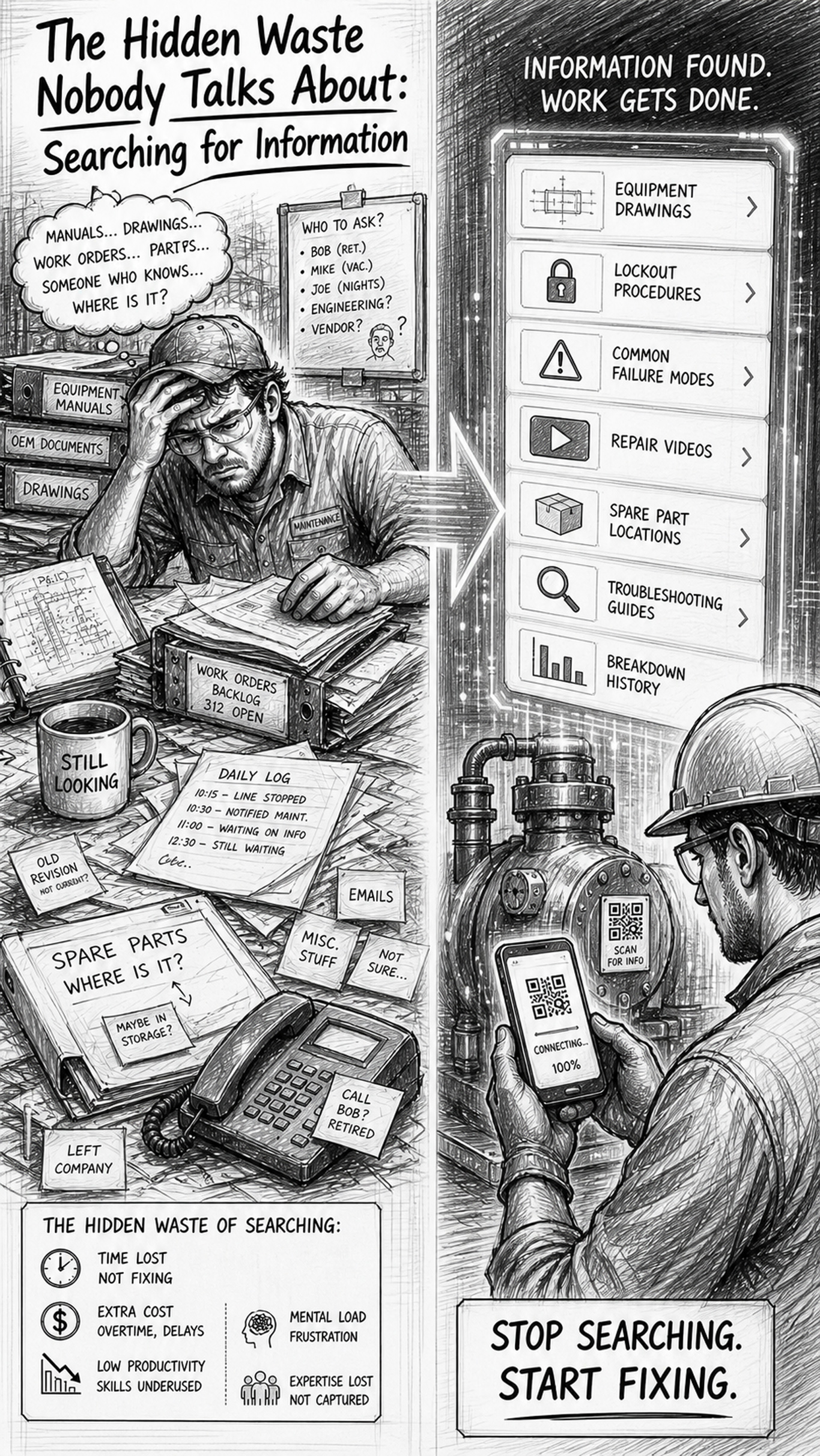
Imagine a technician scanning a QR code on a piece of equipment and immediately accessing equipment drawings, lockout procedures, common failure modes, repair videos, spare part locations, troubleshooting guides, previous breakdown history, standard repair procedures, and lessons learned from earlier failures.
The technician doesn’t spend time searching. The technician starts solving the problem. That changes everything.
Downtime decreases. Repair quality improves. Training becomes faster. Confidence grows. Troubleshooting becomes more consistent and less dependent on individual memory.
Most importantly, organizations stop wasting the experience they already paid to acquire.
Reducing Friction Between Knowledge and Execution
Every breakdown teaches something valuable, every repair contains operational knowledge, and every troubleshooting effort creates insight. Many of those lessons are first discovered through observation on the floor, which is why Gemba remains such a powerful tool for learning and improvement.
Many of those lessons are first discovered through observation on the floor, which is one of the reasons Gemba remains such a powerful tool for learning and improvement.
The problem is that organizations often fail to preserve what they learn. Knowledge remains trapped inside individuals or buried inside disconnected systems, making it difficult to access when it is needed most.
This is why intelligent maintenance systems are becoming increasingly important. Not because they store more data. But because they reduce friction between knowledge and execution.
The strongest maintenance organizations of the future won’t necessarily be the ones with the largest maintenance departments or the most sophisticated software. They’ll be the organizations where information flows with the least resistance and where knowledge reaches people exactly when they need it.
Because in manufacturing, speed isn’t only about how fast you repair equipment.
Sometimes, speed is simply about how fast you can find the answer.
If you enjoy practical discussions about maintenance, reliability, operational excellence, and continuous improvement, connect with me on LinkedIn. I’d be happy to continue the conversation there.