A Database Is Only as Smart as the Information We Give It
One of the biggest surprises I’ve had over the years is how much money organizations spend collecting maintenance data, only to discover years later that they can’t trust it. I’ve also noticed that almost every maintenance organization wants better data. We invest in CMMS software, and we spend months building equipment hierarchies. We also create asset records, define failure codes, document work orders, and carefully organize years of maintenance history.
The goal is always the same. We’re trying to build a knowledge base that helps us make better decisions tomorrow than we made yesterday. Unfortunately, that’s where many organizations make a costly assumption.
They believe that simply collecting data automatically creates knowledge. It doesn’t. A maintenance database will only ever be as valuable as the information people choose to put into it.
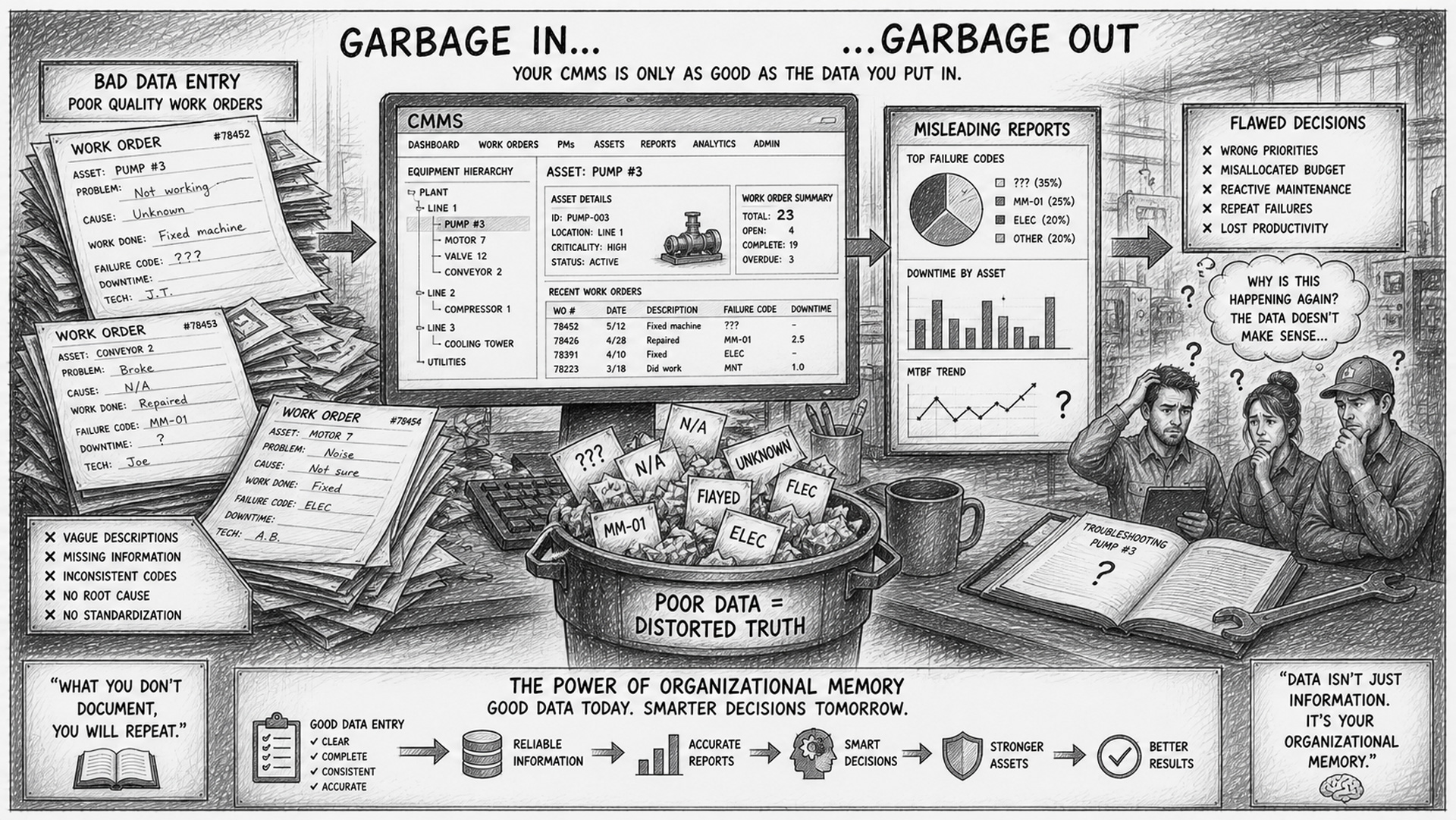
There’s an old saying in information systems that has survived for decades because it’s still true. Garbage in, garbage out. No matter how sophisticated the software becomes, poor information will always produce poor decisions.
Your Maintenance Database Is the Memory of the Organization
Many people think of a maintenance database as nothing more than a place to store information. I’ve never looked at it that way. To me, it’s the organization’s memory. Every work order tells part of a story, every preventive maintenance task, every breakdown, every modification, every lesson learned.
Years from now, someone else will rely on those records to troubleshoot equipment, improve reliability, or make an important maintenance decision. They won’t be standing beside the machine when today’s repair takes place. They’ll only have whatever information we decided to leave behind.
That’s why every work order is really a conversation with someone you’ll probably never meet.
The Most Expensive Work Order Ever Written Might Be the Shortest One
I’ve lost count of how many work orders I’ve seen that simply say: ‘Fixed machine.’
Every time I read one, the same questions come to mind. What failed? Why did it fail? Which parts were replaced? How was the problem diagnosed? How long did the repair take? Were there any unusual operating conditions?
None of those answers exist. Not because nobody knew them. Because nobody wrote them down. At that moment, something valuable disappears. Not the repair. The learning.
Capturing experience is what allows organizations to build knowledge instead of simply collecting history.
Multiply that by hundreds, or even thousands, of work orders over several years, and an organization slowly loses one of its greatest assets. The database begins looking full. But it’s full of activity rather than knowledge.
Every Work Order Is Written for Someone in the Future
One mistake I see quite often is people believing they’re documenting work for today.
They’re not. They’re documenting it for tomorrow.
The technician troubleshooting that machine next year may never have seen this failure before. The reliability engineer analyzing recurring problems may not have been with the company when the breakdown occurred. The planner developing a preventive maintenance strategy might never have worked on that asset.
Every one of them will depend on the quality of the information left behind. That’s why I often say that every work order is a message to the future.
The only question is whether it’ll be useful when someone finally needs it.
Technology Can’t Create Knowledge That Was Never Captured
Today, organizations continue investing in better technology.
New dashboards, more detailed reports, predictive analytics, artificial intelligence, all of those tools have tremendous potential.
But they all depend on one thing. Reliable information. If failure codes aren’t used consistently, reports become misleading. If equipment records aren’t accurate, analysis becomes flawed. And if work order descriptions lack detail, important trends remain hidden.
Technology can analyze information faster than ever before. It cannot recover knowledge that was never captured in the first place.
Good Documentation Is Really Knowledge Management
One of the biggest mindset changes maintenance organizations can make is helping people understand why documentation matters.
Good documentation isn’t administrative work. It’s knowledge management, it’s reliability improvement, and it’s organizational learning. When technicians realize that today’s notes may prevent someone else’s breakdown months, or even years, from now, documentation starts feeling very different.
The objective isn’t collecting more information. It’s leaving behind better information.
Your Maintenance Database Is One of Your Most Valuable Assets
When people talk about assets, they usually think about production lines, motors, pumps, conveyors, and other physical equipment. Those are valuable. But so is the information that keeps them running.
Equipment eventually wears out, people retire, experience leaves with them, a well-maintained database allows the organization to keep learning long after individuals have moved on.
That’s why every work order, every failure code, every comment matters. They’re not simply records. They’re investments in future decisions.
The Quality of Tomorrow’s Decisions Depends on Today’s Information
The phrase ‘Garbage in, garbage out’ has been around for decades. Despite all the advances in technology, it’s just as relevant today as it was when it was first coined.
If we want reliable troubleshooting, reliable planning, and reliable decision-making, we have to begin with reliable information. Because the quality of every maintenance database, and every decision built upon it, will always depend on what we choose to put into it.
If you enjoy practical discussions about maintenance, reliability, leadership, and operational excellence, connect with me on LinkedIn. I’d be happy to continue the conversation there.