The Kind of Leader I’ve Always Wanted to Be
Over the years, people have asked me what kind of leader I try to be.
There are plenty of leadership models to choose from. We hear about transformational leadership, servant leadership, situational leadership, and many others. They all have value, and I’ve learned something from each of them.
But if I’m honest, I’ve never been very interested in finding the right label. I’ve always been more interested in one simple question. When I walk away, do people feel more capable than they did before I arrived?
For me, that’s the measure of leadership. It’s also why, if I had to describe my own approach, I would call myself a self-efficacy leader.
Not because it’s a popular leadership theory, but because I’ve seen firsthand what happens when people genuinely believe they can solve the problems in front of them.
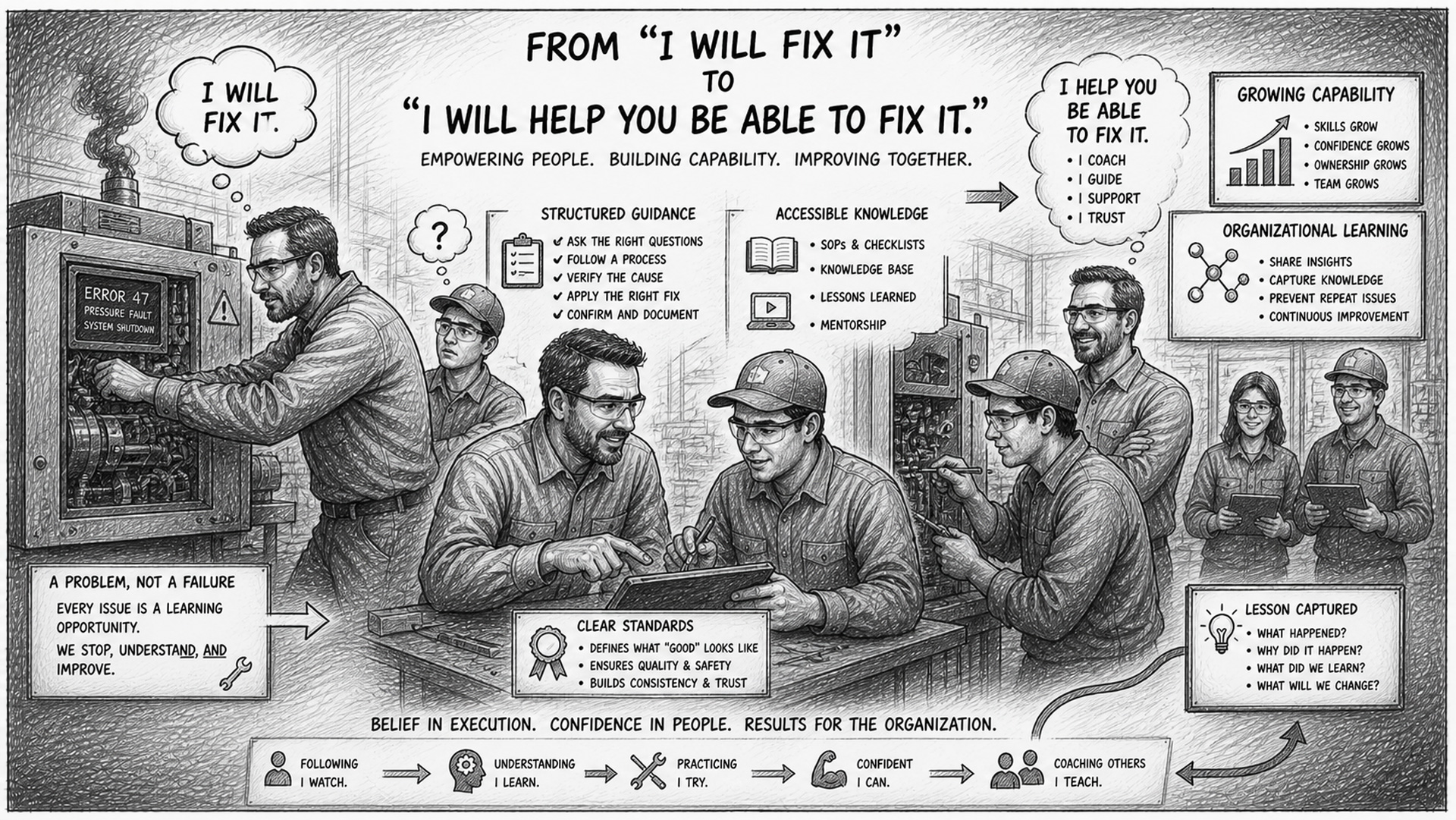
Confidence Is Built Long Before the Machine Breaks Down
One thing manufacturing has taught me is that confidence doesn’t suddenly appear during a crisis.
It has already been built, or slowly eroded, long before the machine stops, the production line falls behind, or everyone starts looking for answers.
That’s really what self-efficacy is. It’s the belief that, even in difficult conditions, you can figure things out. Not because someone told you that you could. Because you’ve experienced it before.
I’ve seen highly skilled technicians hesitate because they no longer trusted themselves. I’ve also seen people with far less experience step confidently into difficult situations because they believed they could work through the problem.
Technical ability certainly matters. But belief matters too.
Do technicians believe they can solve the failure, do operators believe they’ll notice an abnormal condition before it becomes a breakdown, do supervisors believe they can lead when the pressure starts building, or do teams believe they can improve, even after a difficult week?
Those questions matter more than many leaders realize. When people believe they’re capable, performance expands. When they don’t, even great skills often remain unused.
Leadership Should Build Capability, Not Dependence
One lesson I’ve carried with me throughout my career is that leaders shouldn’t become the answer to every problem. It’s tempting.
People come to you because you have experience. You already know the answer, so it’s faster to solve the problem yourself. But every time we do that, we miss an opportunity to help someone else grow.
Over time, I stopped asking myself, ‘How can I solve this?’. Instead, I began asking, ‘How can I help someone else solve this?’. That small shift changed the way I looked at leadership.
The goal was no longer to become indispensable. The goal became helping other people become more capable every day. When confidence and competence grow together, something interesting happens. People stop waiting for instructions. They begin thinking for themselves.
Confidence Can Disappear Faster Than We Think
I’ve also learned that confidence is surprisingly fragile. It doesn’t usually disappear overnight. It fades little by little. A difficult troubleshooting job that doesn’t go well. Several unresolved breakdowns. A lack of coaching. Little feedback. Few opportunities to succeed.
Individually, none of those moments seem particularly important. Together, they slowly convince people to stop trusting their own judgment.
I’ve watched talented people become hesitant simply because they experienced too many situations where they felt unsupported. And hesitation is expensive in maintenance. It delays decisions. It delays repairs.
Eventually, it creates the reactive firefighting every organization is trying to avoid. The longer that cycle continues, the harder it becomes to build the reliability everyone is working toward.
People Don’t Build Confidence by Watching Leaders
One mistake I think many leaders make is believing confidence comes from encouragement alone. It doesn’t. Encouragement helps. Experience changes people.
When someone successfully diagnoses a difficult problem, even with a little coaching, they begin seeing themselves differently. They stop thinking, ‘Maybe I can do this.’ They start thinking, ‘I’ve done it before. I can do it again.’
That’s why I believe coaching is so much more powerful than simply providing answers. Sometimes the most valuable thing a leader can do is resist the temptation to solve the problem and instead ask one more question.
The objective isn’t to remove difficulty. It’s to help people discover that they’re capable of working through it.
Failure Should Build Confidence, Not Destroy It
I’ve often wondered why we’re so patient when investigating equipment failures but so impatient when trying to understand people.
When a machine fails, we perform Root Cause Analysis. We gather evidence, we ask questions, and we look beyond the obvious explanation because we know failures rarely happen for just one reason.
People deserve that same curiosity. In organizations where confidence is low, mistakes become personal. People begin avoiding difficult work because failure feels like judgment.
Healthy organizations see failure differently. Failure becomes information. It becomes another opportunity to learn. Especially in maintenance, where breakdowns are inevitable, the question isn’t simply what failed.
It’s what the failure is trying to teach us. That single shift changes how people think about ownership. Instead of protecting themselves, they begin engaging with the problem.
Understanding Matters More Than Results
One thing I’ve noticed over the years is that many organizations celebrate successful repairs without ever discussing how the solution was found. The machine is running again. Everyone moves on.
But the real value wasn’t getting the equipment running. It was understanding why it failed in the first place.
People need to hear the thinking behind the decision. Why was one possibility eliminated? What evidence pointed toward the root cause? How did the team know they were moving in the right direction?
Without those conversations, knowledge stays with individuals. It never becomes organizational knowledge. That’s why capturing experience is every bit as important as solving the problem itself.
Simple Systems Build Confident People
Over time, I’ve also realized that confidence isn’t built only through coaching. Sometimes it’s built through better systems.
When documentation is difficult to find, when procedures are inconsistent, and when expectations change from one shift to another, people begin doubting themselves. Not because they’re incapable. Because the environment makes success unnecessarily difficult.
Clear standards. Accessible knowledge. Simple processes. Those aren’t just operational improvements. They’re confidence-building systems.
The Question Every Leader Should Leave Behind
One of the most rewarding moments for any leader isn’t hearing someone ask, ‘Can you help me?’ It’s hearing them say, ‘I think I know how to approach this.’
That’s when you know confidence has taken root. That’s when leadership begins multiplying instead of centralizing. Teams become more resilient. Learning accelerates. Ownership grows. And people begin believing they’re capable of solving problems that once seemed overwhelming.
For me, that’s what self-efficacy leadership has always been about. Not creating followers. Creating people who trust themselves. Because in the end, leadership isn’t measured by how many problems we solve ourselves. It’s measured by how many people believe they can solve problems after we’ve gone.
If you enjoy practical discussions about continuous improvement, maintenance, reliability, leadership, and operational excellence, connect with me on LinkedIn. I’d be happy to continue the conversation there.