The Best Improvements Start With a Question
Walk through almost any manufacturing plant and you’ll hear people talking about continuous improvement. You’ll see Kaizen events, Lean workshops, Root Cause Analysis sessions, performance boards, KPIs, action plans, and improvement projects. All of those tools have their place, and I’ve used them throughout my career.
But after spending years working in maintenance and reliability, I’ve come to realize something. I’ve seen organizations invest in every improvement tool imaginable, yet very little changed. Because tools don’t improve organizations. People do. And people improve only when they’re willing to stay curious.
That’s why I believe every meaningful improvement begins long before the first Kaizen event or the first action plan. It begins when someone asks a question that nobody else thought to ask.
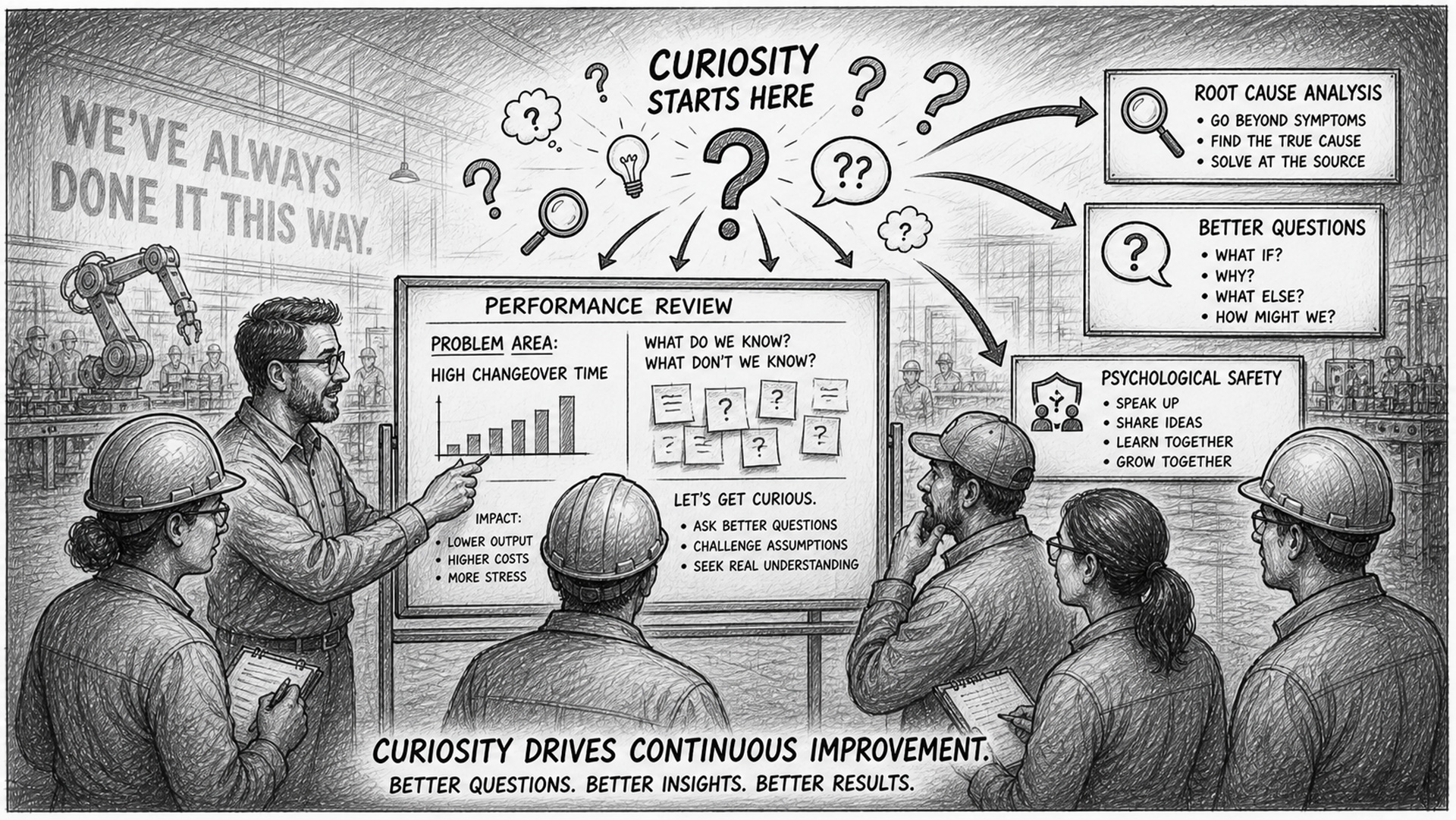
Curiosity Is Where Every Improvement Begins
When I look back at some of the biggest improvements I’ve been part of, they all started the same way. Someone became curious. Why does this machine keep failing, why does this process always take longer than expected, why are operators working around this problem instead of solving it, why have we accepted this as “the way we’ve always done it?
Those questions seem simple. Yet they’re often the beginning of real change. The moment we stop asking questions, improvement starts slowing down. Processes become routines, recurring problems begin to feel normal, and waste slowly disappears into the background until nobody notices it anymore.
Eventually, mediocrity stops looking like a problem.
It simply becomes the culture.
Better Questions Lead to Better Decisions
Curiosity doesn’t eliminate accountability. It changes the questions we ask. When something goes wrong, it’s easy to look for the person responsible.
Curious leaders look for something different. Instead of asking, ‘Who made the mistake?’ they ask, ‘What allowed the mistake to happen?’ Instead of asking why someone forgot an inspection, they ask what made that inspection easy to miss. And instead of wondering why people don’t follow the process, they step back and ask whether the process actually supports the people expected to follow it. The only way to answer that honestly is to spend time where the work is actually being done.
That shift changes everything. The goal is no longer finding someone to blame. The goal becomes understanding the system well enough to improve it, because the first explanation is rarely the whole story.
The Same Thinking That Fixes Machines Should Guide Leadership
Anyone working in maintenance understands that equipment rarely fails because of one single cause.
A bearing might fail because lubrication wasn’t consistent. Alignment may have been slightly off. Contamination could have entered the housing. Operating conditions may have changed, or perhaps the wrong component was installed during an earlier repair.
That’s exactly why Root Cause Analysis works. It refuses to accept the first explanation. Looking beyond the immediate failure is what allows organizations to improve reliability instead of simply repairing equipment.
I’ve often wondered why we’re so patient when investigating equipment failures, yet so impatient when trying to understand people. Machines deserve careful investigation. People deserve it even more.
The Six Words That Quietly Stop Improvement
Over the years, I’ve heard one sentence that quietly ends more improvement ideas than almost anything else. ‘We’ve always done it this way.’
Those six words sound harmless. In reality, they discourage innovation, silence new employees, and slowly convince experienced people that challenging old assumptions isn’t worth the effort.
Continuous improvement asks us to replace that sentence with a different one. ‘Is there a better way?’
Sometimes the answer is no. But asking the question keeps the organization learning. And learning organizations rarely stand still for long.
Curiosity Creates the Confidence to Speak Up
People don’t share ideas simply because suggestion boxes exist.
They share ideas because they believe someone will genuinely listen. If every suggestion is dismissed, people eventually stop making them, if every mistake is punished, people stop admitting them, and if every question is treated as criticism, curiosity slowly disappears. Organizations learn the most when mistakes become opportunities to understand what the failure is trying to teach rather than opportunities to assign blame.
The result isn’t that people stop caring. They simply stop believing their voice matters.
The strongest leaders create the opposite environment. They make it safe to ask questions, challenge assumptions, and admit uncertainty because that’s where improvement begins. They also recognize that every question is an opportunity for someone to learn, and for the entire organization to become stronger.
Leadership Sets the Tone
One lesson I’ve learned is that the most curious person in the room should usually be the leader. If the leader stops asking questions, the rest of the organization usually does too.
Asking better questions consistently isn’t something leaders do occasionally. It becomes part of their daily leadership routine.
When leaders ask thoughtful questions, everyone else starts asking better questions too. When leaders admit they don’t have every answer, they give others permission to contribute. And when leaders genuinely listen instead of waiting to speak, improvement accelerates.
Curiosity spreads through an organization just as quickly as certainty does. The culture simply reflects whichever one leaders demonstrate more often.
The Best Organizations Never Stop Learning
World-class organizations don’t succeed because they experience fewer problems. They succeed because they learn faster than everyone else. Every breakdown becomes a lesson, every near miss becomes an opportunity, and every customer complaint becomes valuable feedback.
The real advantage comes when those lessons become organizational knowledge that future teams can build on instead of having to rediscover. Even success deserves investigation because understanding why something worked makes it much easier to repeat.
Learning isn’t an event you schedule once a year. It’s a habit that becomes part of everyday work. And every habit begins with curiosity. The strongest organizations create space for those conversations every single day instead of waiting for formal improvement events.
Continuous Improvement Starts With Better Questions
Continuous improvement isn’t a department. It isn’t a project. And it certainly isn’t something that happens only during Kaizen week. It’s a way of thinking built on one simple belief.
There’s always something more to learn. The day we believe we already have all the answers is usually the day improvement begins slowing down.
So before offering the next answer, ask one more question. Before accepting the current process, challenge one assumption, and before solving the problem in front of you, look for one more perspective. Because continuous improvement doesn’t begin with better tools. It begins with better questions. And better questions always begin with curiosity.
Curiosity costs nothing. But over time, it may become the most valuable investment an organization ever makes.
If you enjoy practical discussions about continuous improvement, maintenance, reliability, leadership, and operational excellence, connect with me on LinkedIn. I’d be happy to continue the conversation there.