The First Story Is Rarely the Whole Story
One of the most dangerous habits I’ve seen in leadership isn’t making the wrong decision.
It’s making the decision too early. A machine breaks down, and someone immediately says, ‘Maintenance missed the inspection.’ An operator makes a mistake, and the conclusion becomes, ‘They just don’t care.’ Production misses a target, and suddenly everyone agrees that Operations wasn’t prepared. Sound familiar?
We’ve all heard conversations like these. Sometimes they’re true. Most of the time, they’re only part of the story. And that’s where problems begin.
The first explanation is often the easiest one to accept because it gives us certainty. Unfortunately, certainty can also stop curiosity. Once we believe we’ve found the answer, we stop looking for a better one. The strongest organizations resist the urge to look for someone to blame and instead focus on understanding what the failure is trying to teach them.
I’ve learned over the years that some of the biggest leadership mistakes happen not because people ignore the facts, but because they believe they’ve found them too soon. That’s one reason I believe the best leaders spend time where the work actually happens instead of relying only on reports and second-hand explanations.
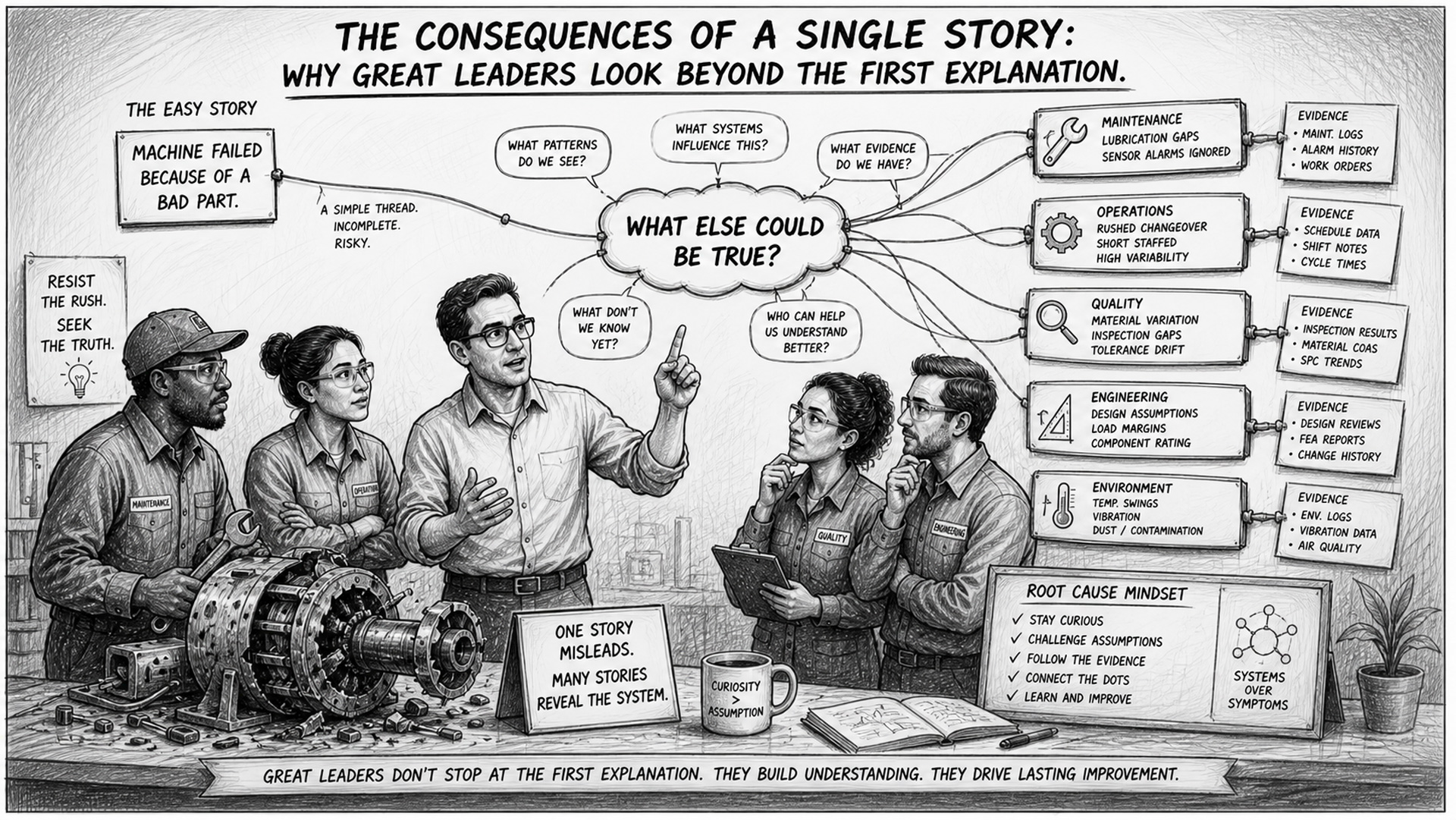
Every Problem Has More Than One Story
As leaders, we’re wired to look for patterns.
Our brains like simple explanations because they help us make quick decisions.
The problem is that simple explanations often become permanent beliefs.
Eventually, assumptions replace evidence. Departments begin blaming one another, people stop asking questions, and trust slowly disappears. Strong daily conversations make it much harder for assumptions to replace facts because problems become visible long before they turn into blame. Before long, the organization is no longer learning from problems. It’s simply assigning them to someone else.
I’ve seen this happen more times than I’d like to admit. And in manufacturing, the cost of accepting the first story can be much higher than most people realize.
The Cost of Getting the Story Wrong
In manufacturing, accepting the first explanation can become very expensive.
Imagine a bearing that keeps failing.
Everyone agrees the problem must be lubrication. Maintenance schedules become stricter. Technicians receive additional training. Audits increase.
Months pass. The failures continue. Eventually, someone discovers the bearing housing was slightly misaligned during installation. Repairing the bearing solved the immediate issue, but understanding why it failed is what ultimately improves reliability over the long term. The original story wasn’t completely wrong. It simply wasn’t complete.
By then, the plant has already paid the price through unnecessary work, lost production, and damaged confidence in the maintenance team.
The real issue wasn’t lubrication. It was the decision to stop asking questions too soon. Lasting improvement only happens after the team fully understands the problem instead of rushing toward the first solution that seems obvious.
People Deserve Root Cause Analysis Too
I’ve often wondered why we’re so disciplined when investigating equipment failures, but not nearly as disciplined when we’re dealing with people.
When a machine breaks down, we don’t stop after the first explanation. We perform Root Cause Analysis because we know failures rarely happen for just one reason.
Yet when an employee struggles, we often jump straight to conclusions: ‘He’s difficult’, ‘She’s not leadership material’, ‘That operator always causes problems’.
Maybe. Or maybe we’re only hearing one chapter of a much longer story. Perhaps they’ve never received proper training, perhaps they’re carrying responsibilities outside work that nobody knows about, perhaps they’ve spent years feeling ignored. Or perhaps they’re simply afraid of making another mistake.
When we reduce people to labels, we stop seeing their potential. Great leaders don’t label people. They become curious about the circumstances instead.
Organizations that encourage learning instead of judgment create environments where people are much more willing to share what they know and admit what they don’t.
Curiosity Is a Leadership Skill
Some of the strongest leaders I’ve worked with weren’t the ones who had the quickest answers.
They were the ones who asked better questions. What are we missing? Who hasn’t been heard yet? What assumptions are we making? What evidence supports this conclusion? Is there another explanation?
Curiosity slows us down just enough to prevent costly decisions based on incomplete information. And slowing down for a moment often allows us to move much faster later. Asking better questions isn’t a personality trait. It’s a leadership habit that becomes part of everyday routines.
Seeing the Whole System
One of the lessons Lean taught us is that no department ever sees the entire picture. Maintenance sees one part. Operations sees another. Quality notices something different. Engineering brings another perspective.
The people doing the work every day often notice things no report will ever capture. The challenge for modern organizations is making sure those observations become shared organizational knowledge instead of disappearing when people move on. That’s why I believe the best decisions rarely come from the loudest voice in the room. They come from combining perspectives.
Only then do you begin seeing the whole system instead of one small piece of it.
Leadership Begins With Better Questions
The best leaders I’ve known were never obsessed with being right. They were committed to understanding.
Every failure has multiple causes, every success has multiple contributors, every employee has a story, every department has constraints, every organization has blind spots. Leadership begins the moment we realize one story is never enough.
The next time someone tells you exactly why something happened, resist the temptation to accept the first explanation.
Pause. Ask another question. Then ask one more. Because the quality of our leadership is often determined not by the stories we hear, but by the ones we’re willing to keep exploring.
If you enjoy practical discussions about leadership decision making, maintenance, reliability, and continuous improvement, connect with me on LinkedIn. I’d be happy to continue the conversation there.