Every Minute of Production Starts Somewhere
Walk through almost any manufacturing plant and ask one simple question: ‘What is the purpose of the maintenance department?’
Most people answer almost immediately. They’ll say it’s there to fix broken machines, reduce downtime, repair equipment, and keep maintenance costs under control. None of those answers are completely wrong. They’re just incomplete.
After spending more than two decades in manufacturing and maintenance leadership, I’ve come to believe we’ve been looking at maintenance from the wrong angle. We often describe it as a support function or a necessary expense that keeps production moving.
I don’t see it that way. I see maintenance as one of the biggest capacity creators in the entire business.
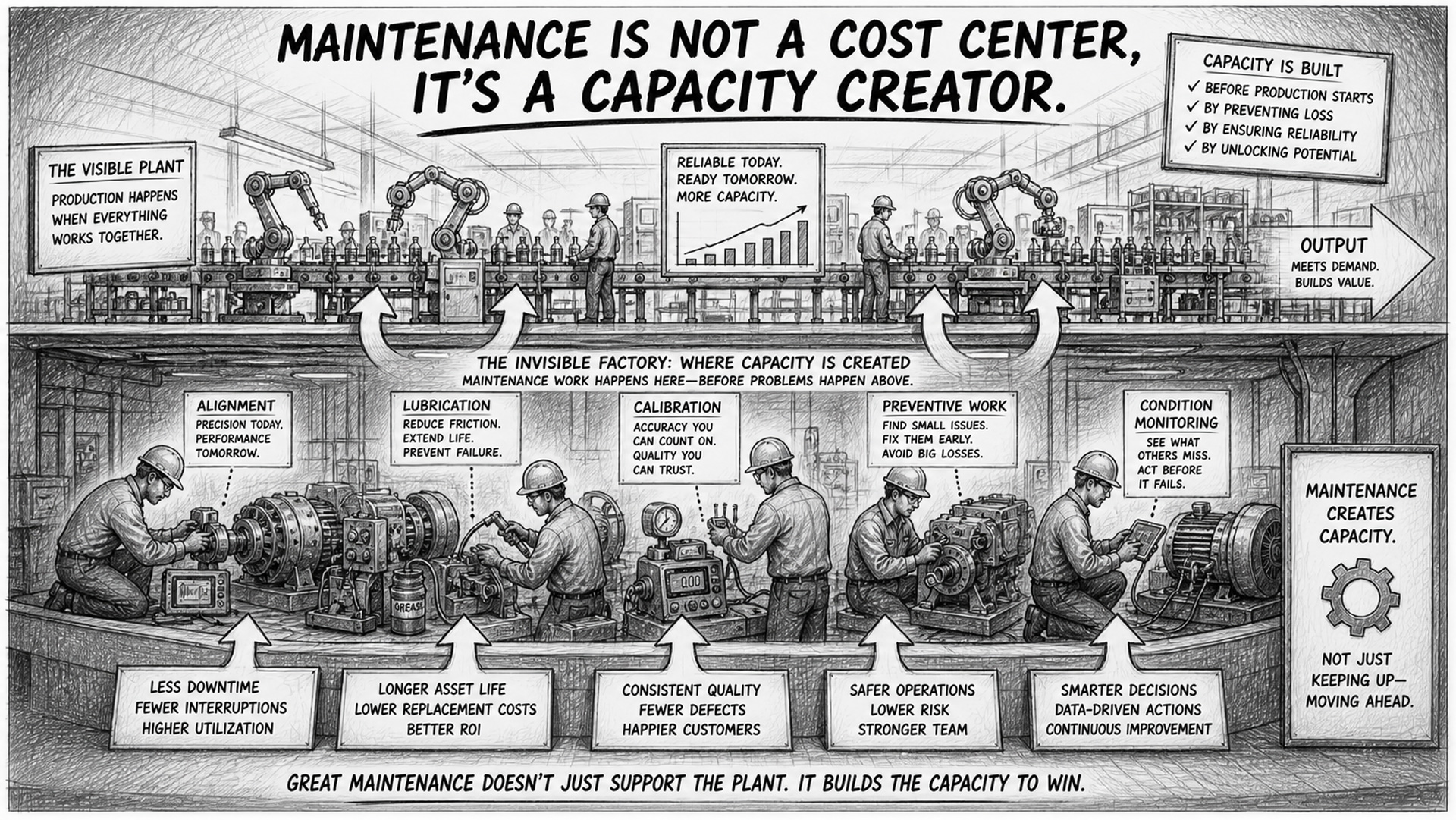
Maintenance Creates Capacity Before Production Ever Starts
When production exceeds its targets, the operations team usually gets the credit.
When production misses its targets, maintenance often gets the first phone call. But both reactions miss something important.
Production can only build what maintenance has already made possible. Every properly aligned motor, every healthy bearing, every calibrated sensor, every conveyor running exactly as it should, and every reliable electrical panel creates the conditions for production to succeed.
Those aren’t simply maintenance activities. They’re the foundation of production capacity. Production doesn’t create machine reliability. It depends on it.
That’s what maintenance creates every single day.
The Factory Inside the Factory
I’ve often thought of maintenance as the invisible factory operating inside every manufacturing plant.
Production converts raw materials into finished products. Maintenance converts unreliable equipment into reliable production capacity.
The interesting part is that when maintenance performs exceptionally well, almost nobody notices. Machines run. Schedules stay on track. Orders ship on time. Customers remain happy. Everything appears effortless.
Ironically, silence is often the greatest compliment a maintenance team can receive. Nobody notices reliability because reliability quietly allows everything else to happen.
Reliability Is Capacity You Don’t Have to Buy
Imagine two identical production lines.
Both were designed to produce 10,000 units during a shift. One experiences three hours of downtime every week. The other loses only thirty minutes.
Nothing changed in operations. The operators have the same skills, the equipment is identical, the difference is reliability.
One organization created additional manufacturing capacity without purchasing another production line. It invested in reliability instead. That’s something many organizations overlook.
Reliability creates capacity you don’t have to buy. That’s one of the highest returns any manufacturing organization can achieve.
Stop Looking Only at Maintenance Costs
When budget discussions begin, maintenance is often viewed through one lens. Cost.
Can we reduce overtime, postpone repairs, or delay replacing aging assets? Can we cut this year’s maintenance budget? They’re understandable questions.
I think there’s a better one. How much manufacturing capacity are we risking by not investing in maintenance? Deferred maintenance doesn’t eliminate costs. It simply postpones them.
Eventually, failures become larger. Repairs take longer. Emergency work replaces planned work. Production becomes unpredictable. Customers begin feeling the impact. That’s exactly why reliability can’t depend on good intentions alone. It has to be supported by consistent daily leadership and follow-up.
What looked like a financial saving often becomes lost production capacity. That’s rarely a good trade.
Maintenance Creates Business Value
The best manufacturing organizations don’t ask maintenance to become cheaper, they ask maintenance to become better. They focus on improving reliability because reliability improves business performance.
Measures like equipment reliability, planned work percentage, schedule compliance, MTBF, MTTR, and Overall Equipment Effectiveness (OEE) aren’t simply maintenance metrics. They’re business metrics.
Every improvement increases the plant’s ability to produce safely, consistently, and profitably. That’s why I believe maintenance creates far more value than most organizations realize.
Today’s Maintenance Protects Tomorrow’s Production
One of the most overlooked responsibilities of maintenance is preparing equipment for work that hasn’t happened yet. Preventive maintenance. Precision alignment. Lubrication. Vibration analysis. Root Cause Analysis. Updating the CMMS is only the beginning. The real value comes when maintenance records become organizational knowledge the entire factory can learn from. Capturing information is valuable only when it becomes knowledge that improves future decisions.
These aren’t simply maintenance tasks. They’re investments in tomorrow’s production schedule. Great maintenance organizations don’t spend their time repairing yesterday’s failures. They spend their time preventing tomorrow’s. They also invest in developing people who can prevent tomorrow’s.
Changing the Conversation Starts With Leadership
Maintenance leaders also carry another responsibility. We have to change how the organization talks about maintenance. That change starts with leaders who reinforce reliability through consistent daily routines.
If we continue describing ourselves as the department that repairs equipment, people will continue viewing maintenance as a cost center. But when we demonstrate how reliability improves throughout, product quality, safety, energy efficiency, customer satisfaction, and overall business performance, the conversation changes.
Maintenance becomes exactly what it has always been. A strategic business function.
Factories don’t become more productive because operators work harder. They become more productive because reliable equipment allows people to perform at their best.
That is what maintenance creates every single day.
Maintenance Doesn’t Cost Capacity, It Creates It
The next time someone describes maintenance as a cost center, ask a different question. How much can this factory produce without reliable equipment?
The answer is simple. Nothing. Maintenance doesn’t just keep machines running. It determines how much the factory is capable of producing, today and tomorrow.
That’s why I believe maintenance is not a cost center. It’s one of the most important capacity creators any manufacturing organization has.
If you enjoy practical discussions about maintenance, reliability, leadership, and operational excellence, connect with me on LinkedIn. I’d be happy to continue the conversation there.